
The CLAT Entrance Exam is the gateway that hundreds of thousands of students across India compete for every year — a single common test whose score, and the rank it produces, National Law Universities rely on for admission through centralised counselling. Our Thane centre exists to help law aspirants in the area prepare for that test the way it's actually structured: reading-heavy, passage-based, and reasoning-driven across all five sections.
Every student who joins begins with a diagnostic assessment, not a formality — a genuine read on where they stand in reading speed, comprehension, reasoning and pace. That baseline shapes the study plan we hand them, so preparation follows the roadmap Learn → Read → Practise → Test → Analyse → Improve → Revise, rather than random, unplanned study.
Classroom teaching is paired with section-wise practice, timed passage work, previous-year questions, and full-length mock tests conducted under exam-like conditions — the repetition that turns comprehension and reasoning ability into genuine exam-day readiness.

CLAT Sections Covered in Depth
Previous-Year & Mock Questions Practised
Participating NLUs CLAT Scores Are Accepted By
Full-Length Mock Tests, Exam-Timed
Thane has several coaching options for law entrance preparation, so we've stayed deliberately focused on the handful of things that actually move a CLAT score — structured teaching, reading-first preparation, and consistent mentorship.
Nearly every CLAT section is built around comprehension passages, so we treat reading speed and accuracy as a foundational skill, not an afterthought — built through daily practice from the very first week.
No prior law background is assumed. Legal Reasoning and Logical Reasoning are taught as learnable skills — principle-to-fact application and argument analysis — built through repeated, reviewed practice.
Full-length mocks follow the actual CLAT format — 120 objective questions, two-hour timing, and the same +1 / -0.25 marking scheme — so students get an honest read on where they stand.
Every mock test is followed by detailed performance analysis covering reading errors, conceptual errors, calculation errors and guessing errors, feeding straight into targeted follow-up practice.

Preparation follows a simple, repeatable cycle — Assess → Plan → Learn → Read → Practise → Test → Analyse → Improve → Perform — so students always know exactly where they are in the journey.
Understanding a student's current reading level, subject knowledge and pace before the first class.
Fundamentals across all five CLAT sections, paired with daily comprehension practice.
Previous-year questions, sectional tests and full-length mocks under exam-like conditions.
Detailed performance analysis, error-log review and structured revision as the exam date nears.
Candidates who have passed, or are appearing for, their Class 12 (or equivalent) examination and meet the current eligibility conditions prescribed by the Consortium of NLUs can apply for CLAT UG — from any stream, Science, Commerce or Arts/Humanities.
A Class 12 (10+2) pass, or equivalent, from a recognised board. Students appearing for board exams in the year of CLAT can apply, subject to proof of passing at the time of admission.
Recent cycles have generally required around 45% aggregate for General/OBC/other categories and around 40% for SC/ST candidates, with the exact figure fixed by the Consortium of NLUs each year.
In recent cycles the Consortium of NLUs has not prescribed an upper age limit for CLAT UG — always confirm the current position from the official notification.
Eligibility percentages, age conditions and category-wise relaxations can change between examination cycles. Always verify current details against the latest official CLAT notification published by the Consortium of NLUs.
The CLAT UG syllabus is built around five sections, each almost entirely passage-based, so strong reading comprehension supports performance across the whole paper.
Comprehension passages drawn from contemporary and historically significant writing, testing reading comprehension, vocabulary in context, main idea, tone, inference and summary.
Passage-based questions drawing on national and international events, government policies and schemes, the economy, science and technology, and legal or constitutional developments in the news.
Recent CLAT UG cycles have used a single-day, single-paper, offline objective-type test of 120 multiple-choice questions across five sections, completed in a single two-hour sitting. All sections are compulsory, and scores from all sections combine into a single overall score — there is generally no sectional cut-off.
| Section | Indicative Weightage* | What It Tests |
|---|---|---|
| English Language | ~20% | Reading comprehension, vocabulary, inference |
| Current Affairs incl. GK | ~25% | Awareness of recent events and general knowledge |
| Legal Reasoning | ~25% | Application of legal principles to facts |
| Logical Reasoning | ~20% | Arguments, assumptions, critical reasoning |
| Quantitative Techniques | ~10% | Basic mathematics and data interpretation |
*Indicative, approximate proportions based on recent CLAT UG papers — not an official, fixed weightage.
The Consortium of NLUs confirms the exact number of questions, marks and any structural change for each cycle in its official notification. Treat the figures above as a preparation guide and verify current-year figures officially before finalising your strategy.
CLAT UG scores are accepted by around 25 National Law Universities, along with a number of other participating institutions and affiliated law colleges, for five-year integrated programmes such as BA LL.B., BBA LL.B., B.Com LL.B. and B.Sc. LL.B.
BA LL.B. (Hons.) · BBA LL.B. (Hons.) · B.Com LL.B. (Hons.) · B.Sc. LL.B. (Hons.) and other integrated programmes, depending on the university.
Litigation, corporate law, legal advisory, law firms, compliance, legal research, policy work, judicial services, civil services, and academia — each requiring its own further qualifications.
GICE Academy does not promise or guarantee admission to any specific institution or any particular employment outcome. Final allotment is determined entirely by the Consortium of NLUs' counselling process.
Guidance Institute for Competitive Exams was founded in 2018 with a vision to provide effective and qualitative education for competitive examinations. Our strength lies in our dedicated and experienced faculty. GICE Academy has emerged as a leading competitive exam institute in Thane with a strong focus on student success.
Career With Us





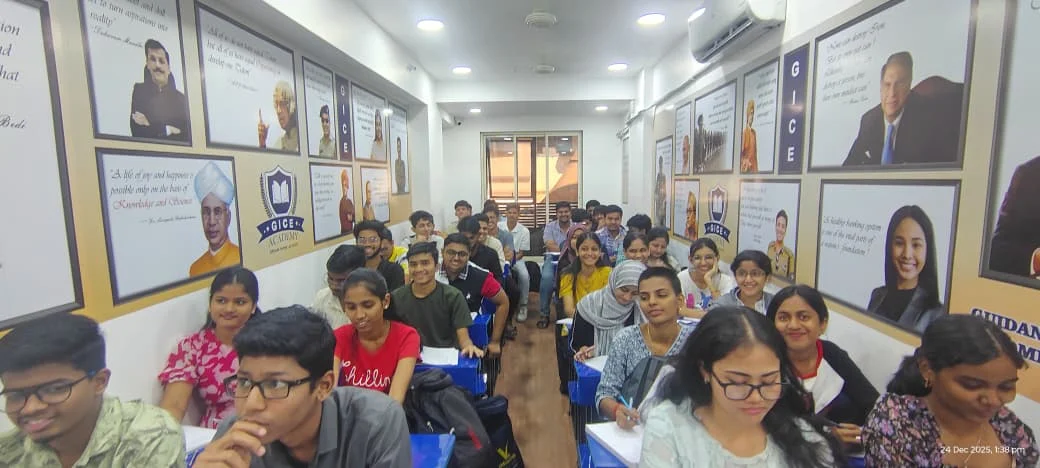
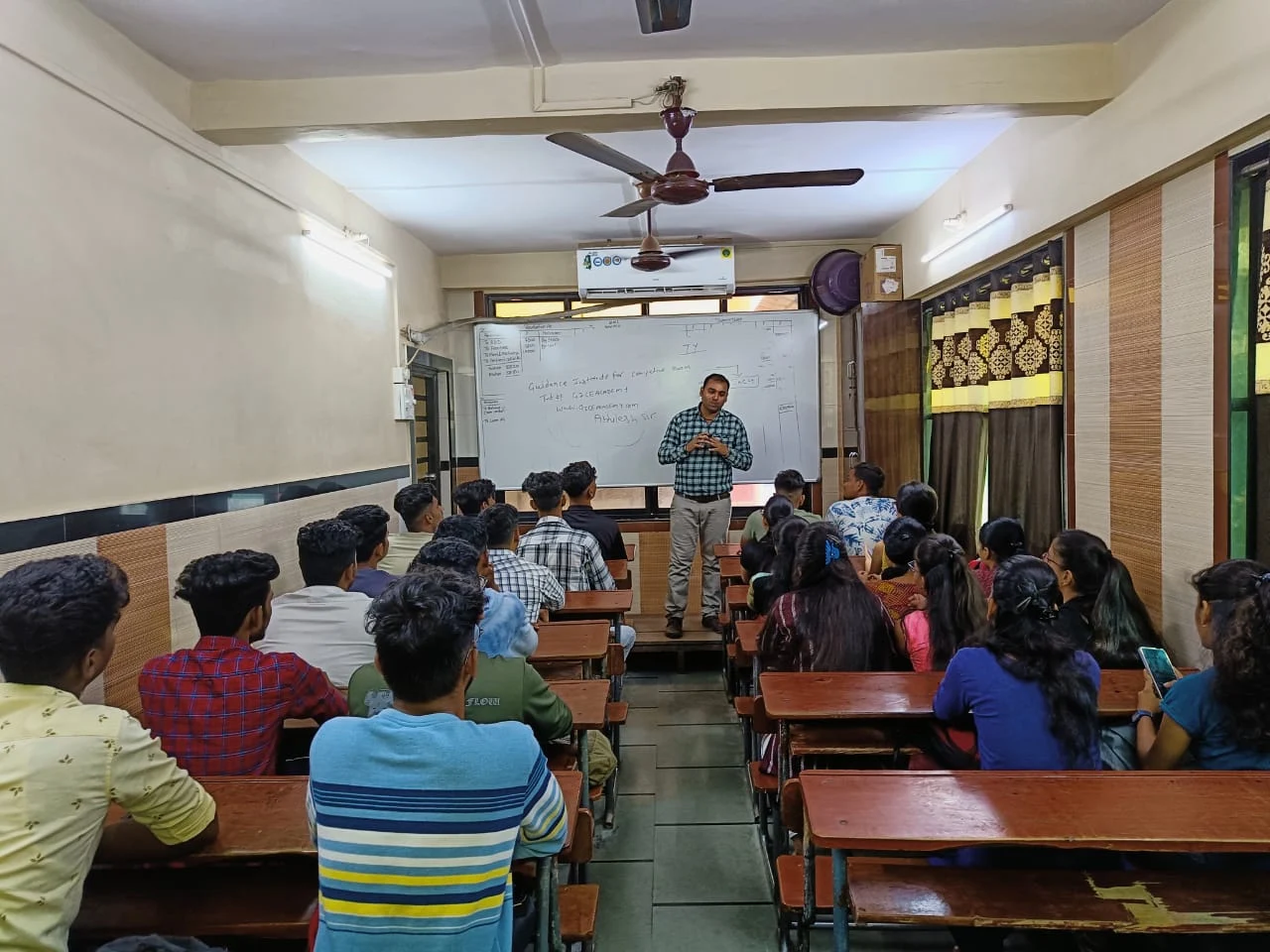
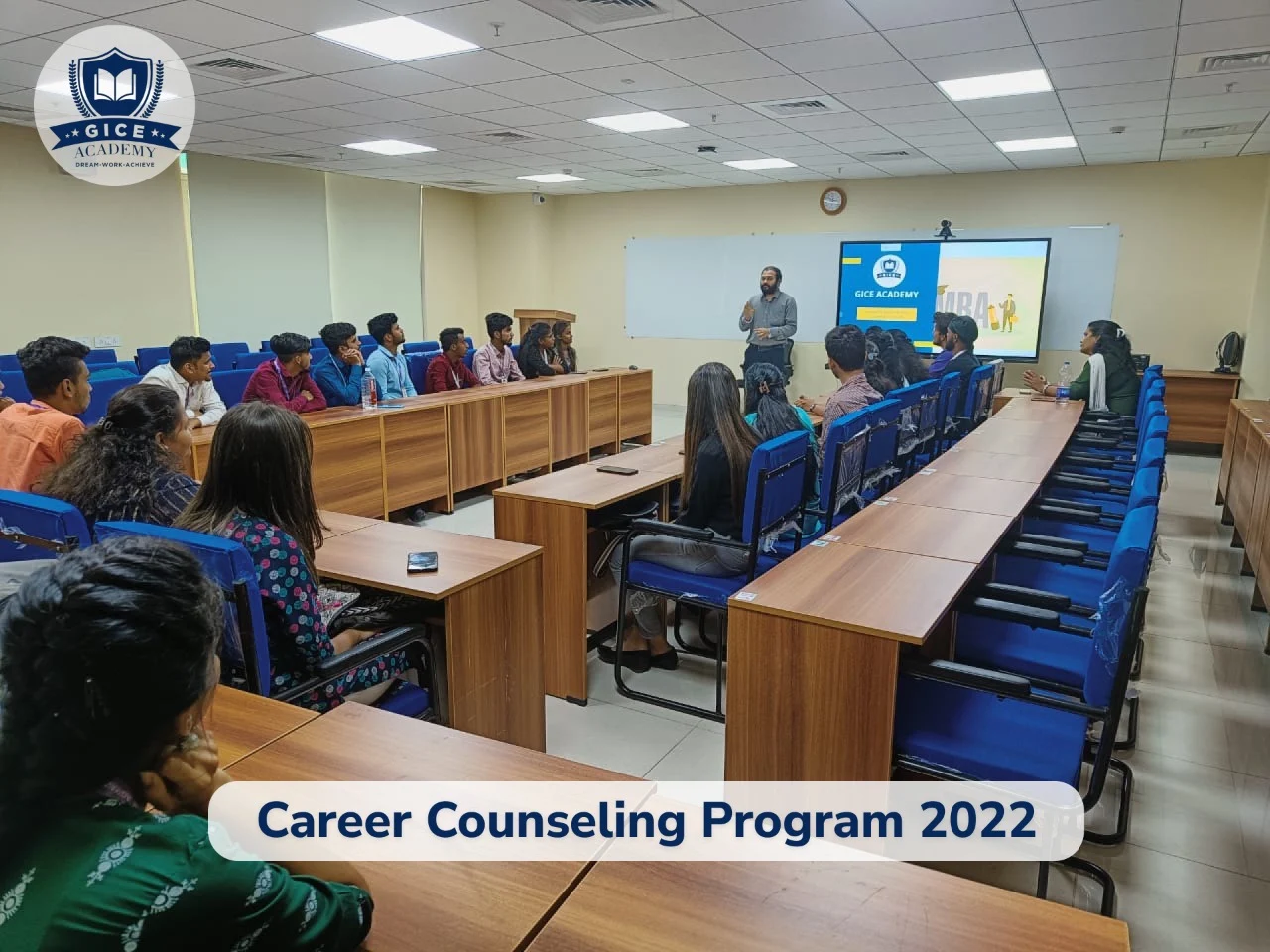
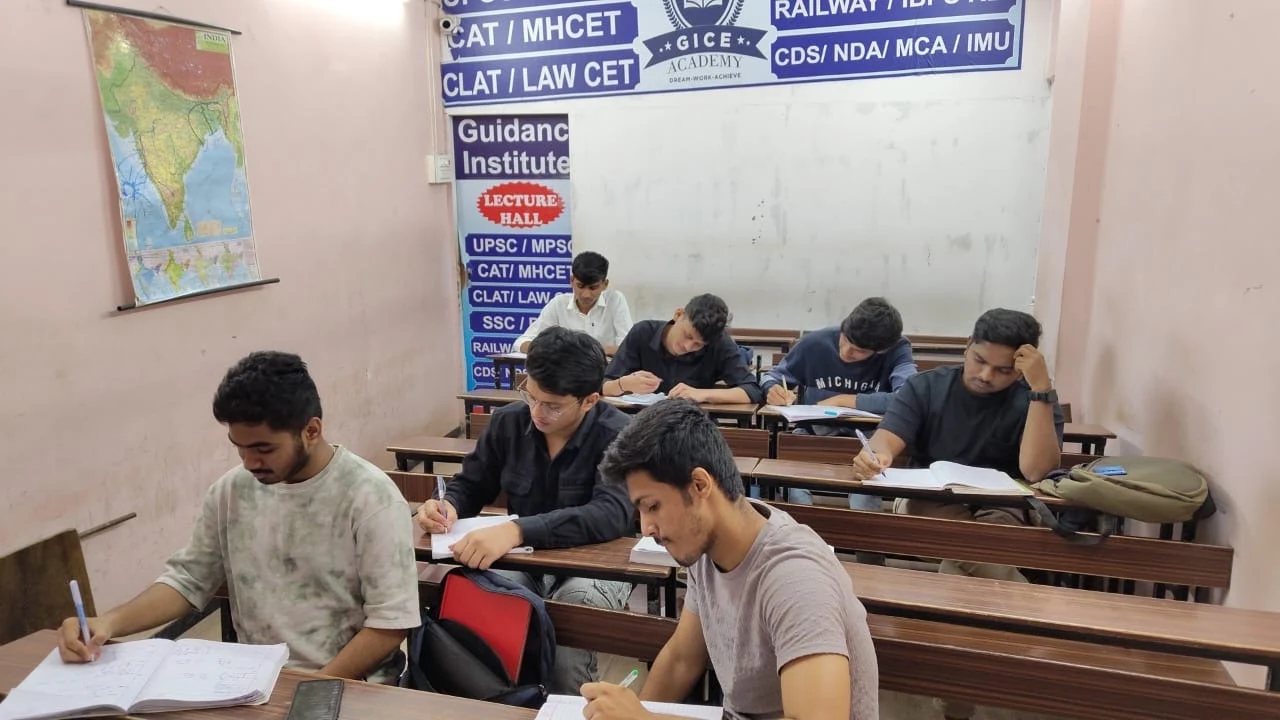
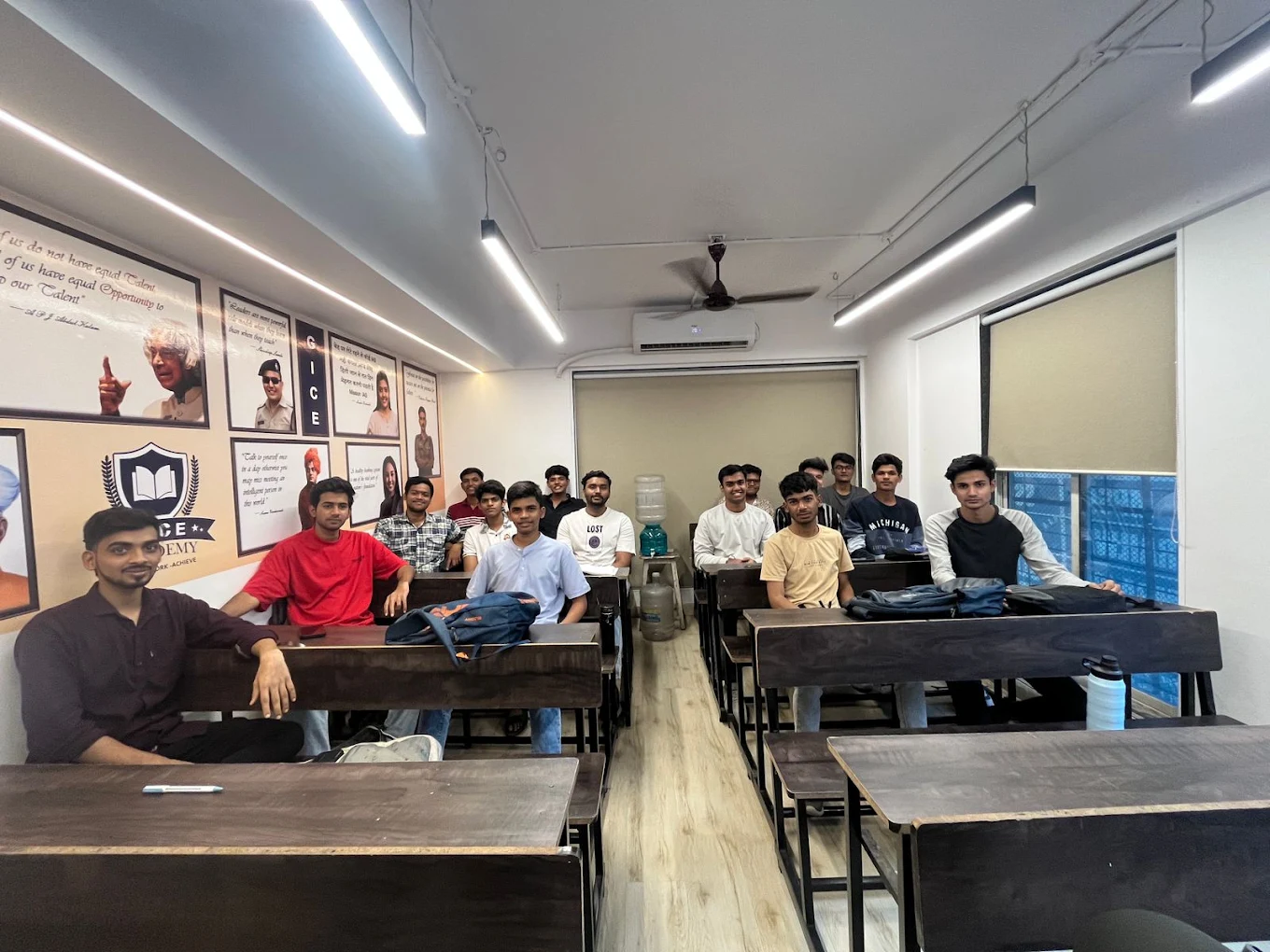
Explore the learning environment and classroom sessions at GICE Academy.
CLAT, the Common Law Admission Test, is a national-level examination conducted by the Consortium of National Law Universities for admission to law programmes at participating NLUs.
Five sections — English Language, Current Affairs including General Knowledge, Legal Reasoning, Logical Reasoning, and Quantitative Techniques — almost entirely passage-based.
Yes. Recent cycles have deducted 0.25 marks for every incorrect answer, with no penalty for questions left unattempted.
No. Legal Reasoning tests the application of a stated principle to given facts — it's a learnable skill built through practice, not prior legal knowledge.
Yes — our schedules are built to sit alongside board-exam preparation, with reading habits and reasoning skills introduced gradually rather than all at once.
Very. They build familiarity with the exam format, sharpen time management, and — when analysed properly — reveal exactly where a student needs to improve.
[Your full address here — building, street, landmark, area, Thane, pincode]