
The GMAT Exam (Graduate Management Admission Test) is a standardised, computer-adaptive admissions test administered by the Graduate Management Admission Council (GMAC), used by business schools and universities worldwide to evaluate applicants to MBA, Master's in Management and other graduate management programmes.
The current GMAT Focus Edition assesses analytical reasoning, quantitative ability, verbal comprehension, and data-driven decision-making — skills that closely mirror the challenges of a business-school classroom. Because the GMAT rewards accuracy, reasoning speed, and strategic thinking rather than rote memorisation, structured and well-guided preparation makes a genuine difference.
Our Dombivli centre supports GMAT aspirants through concept building, guided and progressive practice, realistic mock tests, detailed performance analysis, and consistent faculty guidance and mentorship, following a simple philosophy: Learn → Practise → Test → Analyse → Improve → Perform.

Sections — Quant, Verbal, Data Insights
Years Typical Score Validity
Retakes Permitted in a Rolling 12 Months
Business Schools Accepting GMAT Scores Worldwide
The GMAT Focus Edition rewards conceptual clarity, accuracy and disciplined time management over memorisation. Our Dombivli programme is built around the things that genuinely convert practice into a stronger score.
Quantitative Reasoning, Verbal Reasoning and Data Insights are each built up from fundamentals before timed, adaptive-style practice begins.
Since Data Insights is a core scored section in the current format, we give it dedicated preparation time rather than treating it as a lesser priority next to Quant and Verbal.
Full-length, timed mock tests build the pacing instinct needed for a computer-adaptive format, helping students recognise when to move on from a difficult question rather than over-investing time.
For students planning more than one attempt within the permitted window, we help review section scores and build a focused improvement plan matched to each target business school's expectations.
The current GMAT Focus Edition is built around three core, computer-adaptive sections. Candidates can generally choose the order in which they attempt the three sections at the start of the exam.
Mathematical problem-solving covering arithmetic, algebra, problem solving, number properties and word problems.
Reading comprehension and critical, argument-based reasoning — understanding arguments, assumptions and evidence.
Data sufficiency, multi-source reasoning, table analysis, graphics interpretation and two-part analysis.
Question difficulty adjusts within each section based on performance; an on-screen calculator is available for Data Insights, and no separate AWA or Integrated Reasoning section is included in the current format.
Exact question counts, section timings and scoring details can be revised by GMAC. Always verify current details on the official mba.com website before finalising your preparation plan.
GMAC keeps GMAT eligibility deliberately broad — there is no fixed educational qualification, work-experience requirement, or nationality restriction to sit for the exam.
Candidates aged 18 and above can register independently. Candidates aged 13-17 may be permitted with a parent or legal guardian's written consent. There is no upper age limit.
No specific undergraduate degree, academic stream or minimum GPA is required by GMAC. Most business schools, however, expect applicants to hold or be completing an undergraduate degree at the time of MBA admission.
A valid, original, government-issued photo ID is required at the time of the test, and registration is completed through the candidate's official mba.com account.
Candidates can generally take the GMAT up to five times within any rolling 12-month period, with a required waiting period between attempts. Scores are typically valid for five years.
Individual MBA programmes may add their own requirements, such as a completed bachelor's degree, minimum work experience, or English-language proficiency scores. Always verify current details on the official mba.com website.
The GMAT syllabus is organised around the three core sections of the current GMAT Focus Edition. Candidates should always confirm the latest topic list on the official GMAT website, as GMAC may refine content areas over time.
Arithmetic (number properties, fractions, decimals, percentages, ratios, proportions), averages and statistics-based problem solving, algebra (equations, inequalities, expressions), and word problems requiring translation of real-world scenarios into mathematical reasoning.
Reading comprehension (main ideas, tone, author's purpose, detailed information) and critical reasoning (understanding arguments, identifying assumptions, drawing inferences, evaluating evidence and conclusions).
The figures below reflect the current GMAT Focus Edition format and should be verified against the official mba.com website before being relied upon.
| Section | What It Tests | Major Preparation Areas |
|---|---|---|
| Quantitative Reasoning | Mathematical problem-solving | Arithmetic, algebra, problem solving, word problems |
| Verbal Reasoning | Reading comprehension & critical reasoning | Argument evaluation, inference, evidence |
| Data Insights | Data interpretation & decision-making | Data sufficiency, multi-source reasoning, graphics |
GMAC can update the pattern, section timing, question counts or scoring before or between cycles. Always verify the latest official pattern on mba.com before beginning serious preparation.
While each business school follows its own process, the general journey from GMAT preparation to MBA admission typically follows these broad steps.
Register via your mba.com account
At a test centre or online
Total, sectional & percentile
Essays, transcripts, recommendations
Final call from each school
Preparation follows a consistent philosophy — Assess, Plan, Learn, Practise, Test, Analyse, Improve, Perform — with real feedback built into every stage.
Understanding your current level, target score, and specific strengths and weaknesses.
Strong fundamentals across Quantitative Reasoning, Verbal Reasoning and Data Insights.
Topic-wise, sectional and full-length mock tests simulating the real adaptive format.
Detailed performance analysis, mentorship, and a consolidated exam-day and retake strategy.
The GMAT itself is not a qualification. Career opportunities open up after completing an MBA or management degree pursued via GMAT-based admission at a global business school.
Roles in management consulting and corporate strategy across industries and geographies.
Roles in finance, investment banking and financial services following an MBA specialisation.
Roles in marketing, product management and technology management.
Roles in business and data analytics, operations, HR and general management tracks.
GICE Academy does not promise or predict specific salaries, placements or career outcomes. These depend on the business school, programme, individual profile and prevailing recruitment conditions.
Guidance Institute for Competitive Exams was founded in 2018 with a vision to provide effective and qualitative education for competitive examinations. Our strength lies in our dedicated and experienced faculty. GICE Academy has emerged as a leading competitive exam institute in Thane with a strong focus on student success.
Career With Us





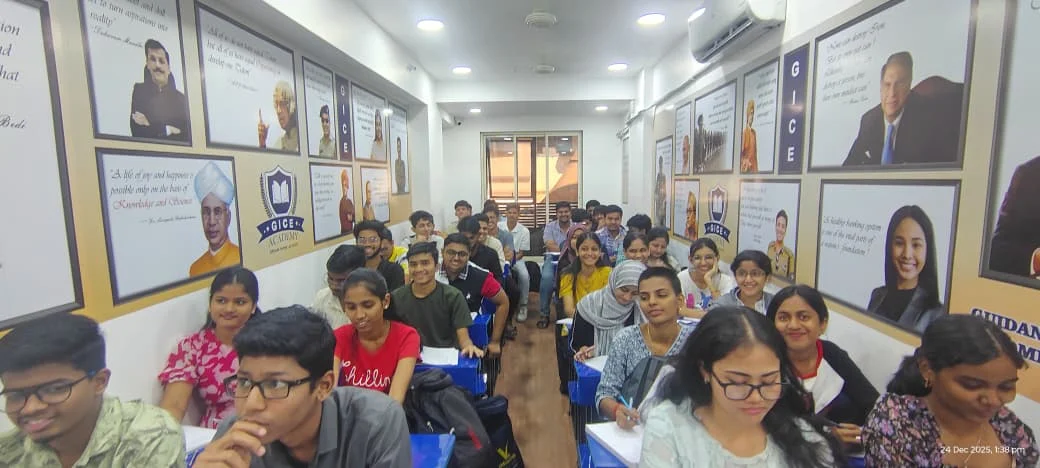
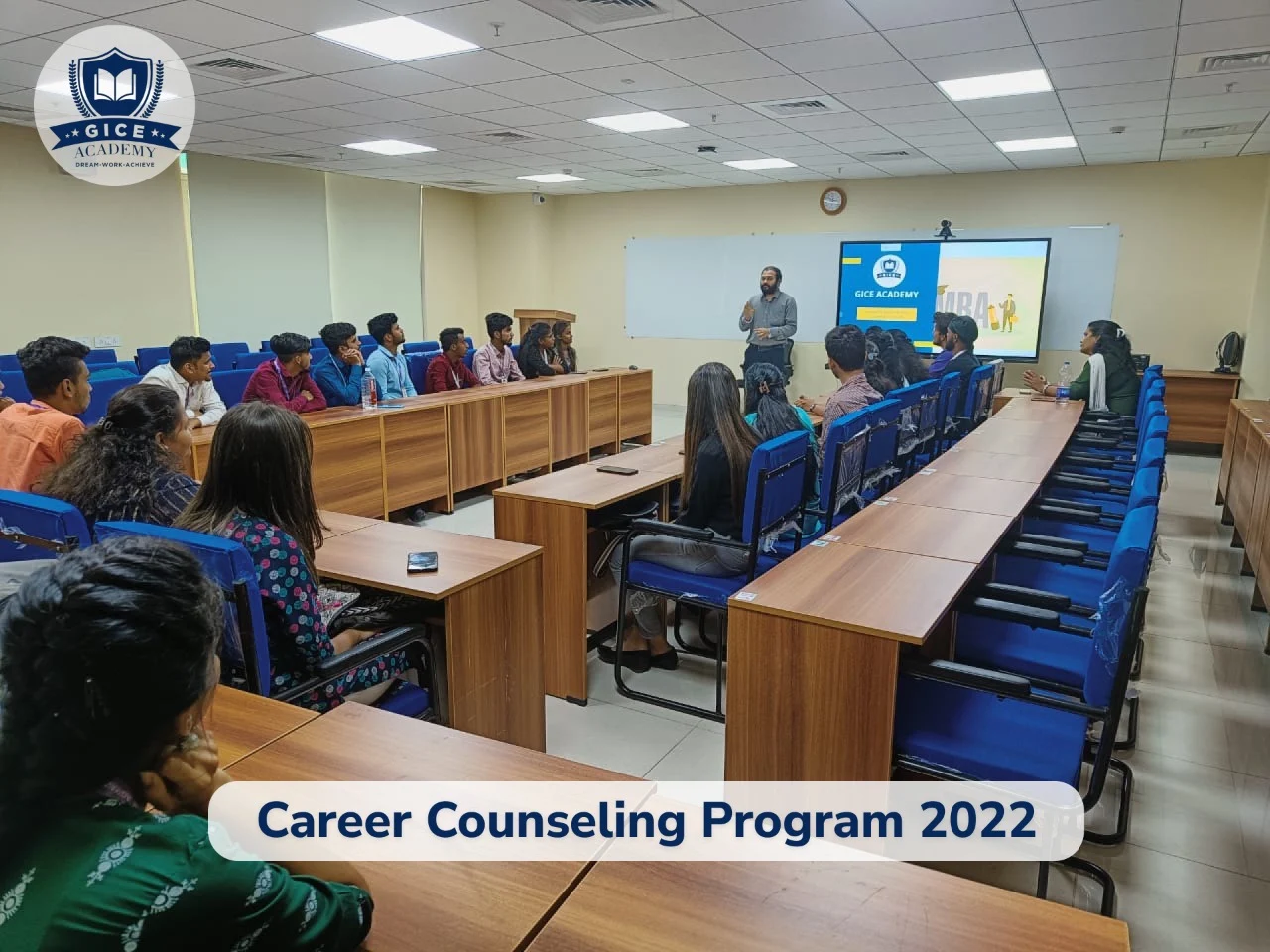
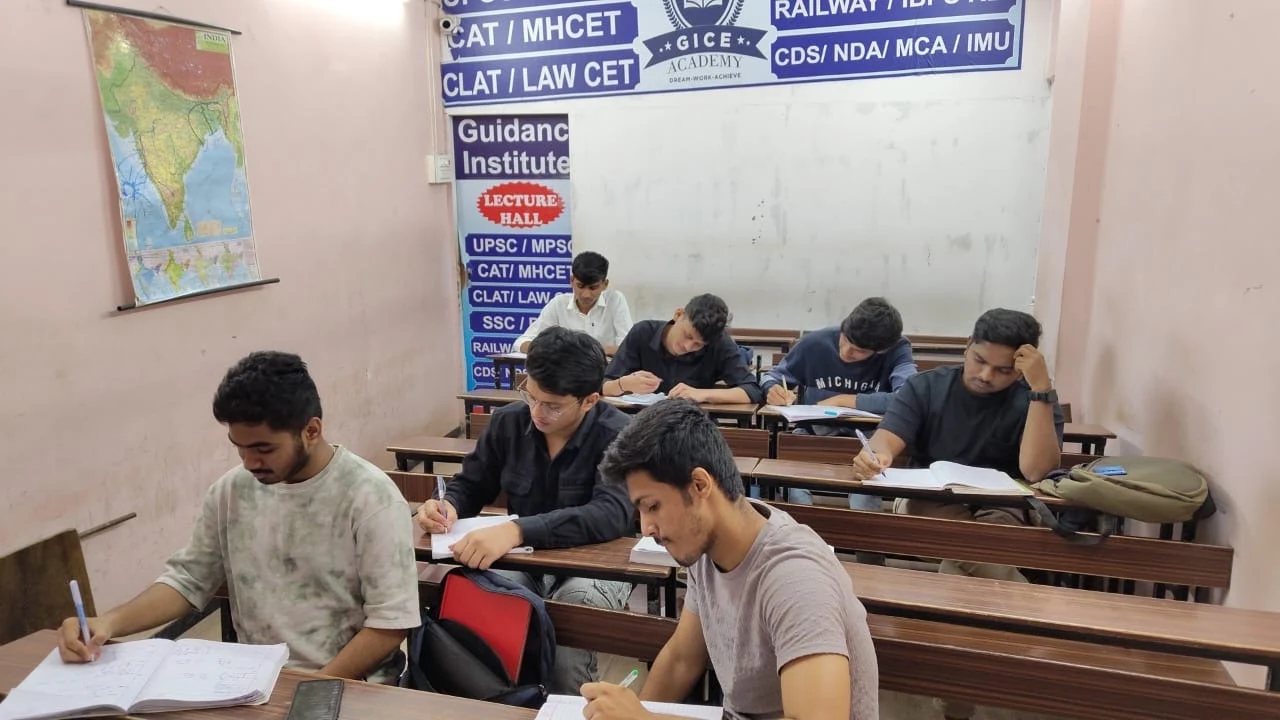
Explore the learning environment and classroom sessions at GICE Academy.


The GMAT Exam is a standardised, computer-adaptive test administered by GMAC that assesses analytical, quantitative, verbal, and data-reasoning skills for admission to MBA and graduate management programmes worldwide.
The current GMAT Focus Edition is a three-section, computer-adaptive format — Quantitative Reasoning, Verbal Reasoning and Data Insights — with flexible section ordering and a limited question review-and-edit option.
GMAT eligibility is broad — no fixed educational or work-experience requirement. Candidates generally must be at least 18 (or 13-17 with parental consent) and register with valid identification.
Candidates can generally take the GMAT up to five times within any rolling 12-month period, with a required waiting period between attempts. Always verify exact rules on the official mba.com website.
A large number of business schools in India and internationally accept the GMAT, though requirements and score expectations vary by institution. Candidates should verify directly with each target school.
Yes — sectional tests, topic tests and full-length mock tests simulating the real adaptive format, along with detailed performance analysis, are built into the preparation journey alongside subject-wise classroom teaching.
[Your full address here — building, street, landmark, area, Dombivli, pincode]