
The NDA Entrance Exam, officially the NDA & NA Examination, is conducted twice a year by the Union Public Service Commission (UPSC) to select candidates for training at the National Defence Academy and the Indian Naval Academy. It gives students the opportunity to join the Army, Navy or Air Force soon after Class 12, and to grow into leadership roles through structured academic and military training.
Our Thane centre supports students through the full journey the written examination covering Mathematics and the General Ability Test, followed by the SSB interview and medical examination. Success calls for strong fundamentals in Mathematics, sharp reading and reasoning skills for the GAT, consistent practice with previous-year questions, and honest self-assessment through mock tests.
Preparing after Class 12 comes with its own pressures board exams, limited time, and an unfamiliar exam pattern. Our structured coaching approach helps students build concepts methodically, track weak areas, and practise under exam-like conditions, while beginning SSB awareness early rather than as an afterthought.

Service Wings — Army, Navy, Air Force
Selection Stages, Application to Training
Written Papers — Mathematics & GAT
NDA Cycles a Year — NDA I & NDA II
Thane has no shortage of coaching options, so we've stayed deliberately focused on the things that genuinely move a candidate through the written exam, the SSB and beyond — not just exam-day marks.
Mathematics is historically one of the toughest sections for many students. We build concept clarity, formula mastery and timed problem-solving practice from the ground up.
English, General Knowledge, Physics, Chemistry, General Science, History, Geography and Current Events are all built into the regular teaching cycle, not left for last-minute revision.
Timed, objective mock tests built around real question-selection pressure, so candidates learn when to attempt a question and when to leave it, not just how to answer it.
The SSB interview evaluates officer-like qualities such as communication, leadership and decision-making. We help students begin building awareness of this stage alongside academic preparation, not after the written result.
Candidates appearing for the NDA Entrance Exam apply for one of three services, each leading to a distinct career path. Exact eligibility conditions for each wing should always be confirmed from the latest official UPSC notification, as these can be revised between examination cycles.
Trains cadets for future roles as commissioned officers in the Indian Army, with emphasis on leadership, ground operations and command responsibilities. Generally does not require Physics and Mathematics at Class 12.
Trains cadets for future roles as officers in the Indian Navy. Because naval training involves technical and engineering concepts, Physics and Mathematics at Class 12 are typically required.
Trains cadets toward future roles as officers in the Indian Air Force, similarly requiring a Physics and Mathematics background. Not every candidate who joins becomes a pilot; roles vary by later selection stages.
Cadets from all three services train together at the tri-service National Defence Academy before moving to their respective service academies for branch-specific training.
Exact eligibility, vacancies and requirements for any NDA wing can vary between notifications. Always verify current details from the official UPSC notification.
NDA Entrance Exam eligibility is determined by UPSC and published afresh with every notification, covering nationality, age, educational qualification, marital status and physical and medical standards.
Candidates who have passed or are appearing in Class 12 are generally eligible. Army wing candidates are generally not required to have studied Physics and Mathematics, while Navy and Air Force wing candidates generally are, based on current norms.
Recent UPSC notifications have specified an age window of approximately 16.5 to 19.5 years as on the course-commencement date. The exact date-of-birth range changes for every notification (NDA I and NDA II are notified separately) always check the current cycle.
Candidates are generally required to be Indian citizens, or meet specific conditions applicable to Nepal, Bhutan or other categories defined by UPSC, and are generally required to be unmarried at the time of application and through training.
Candidates must meet height, weight, vision and general fitness standards prescribed by the Armed Forces medical authorities, confirmed at the medical examination stage after the SSB.
Eligibility conditions can be revised between examination cycles. Always cross-check the latest official UPSC notification before applying.
The NDA Entrance Exam written examination consists of two papers — Mathematics and the General Ability Test (GAT). The exact distribution of topics is specified by UPSC in the official notification for each cycle.
Algebra (sets, relations, quadratic equations), Matrices and Determinants, Trigonometry, Analytical Geometry (two and three dimensions), Differential Calculus, Integral Calculus and Differential Equations, Vector Algebra, Statistics and Probability, Logarithms, Complex and Binary Numbers, Sequence and Series, and Permutations and Combinations.
Part A — English: grammar, vocabulary, comprehension, correct usage and sentence structure. Part B — General Knowledge: Physics, Chemistry, General Science, History, Geography and Current Events, tested at a level appropriate to a Class 10–12 student.
The figures below reflect the general pattern seen in recent examination cycles and should be verified against the current UPSC notification before being relied upon.
| Paper | Subject | Approx. Max Marks | Approx. Duration |
|---|---|---|---|
| Paper I | Mathematics | 300 | 2.5 hours |
| Paper II | General Ability Test (GAT) | 600 | 2.5 hours |
UPSC confirms exact marks, duration and any structural change for each cycle in its official notification. Treat the figures above as a preparation guide and verify current-year figures officially before finalising your strategy.
Candidates must clear each stage before moving to the next. Clearing the written examination is only the first step — final admission depends on SSB performance, medical fitness, applicable merit and available vacancies.
Mathematics & GAT papers
Multi-day officer-quality assessment
Physical & medical standards check
Combined written + SSB marks
Joint training at the NDA
Preparation follows a consistent philosophy — Learn, Practise, Test, Analyse, Improve, Perform — with real feedback built into every stage.
Understanding the student's current level and identifying the target NDA attempt — NDA I or NDA II.
Strengthening Mathematics, English, GAT and Science fundamentals through structured, concept-first teaching.
Previous-year questions, sectional tests and full-length mock tests under timed, exam-like conditions.
Detailed performance analysis after every test, alongside early guidance on SSB preparation.
NDA is a pathway toward officer-level training in the Armed Forces, not an automatic guarantee of a commission. Selected candidates train jointly at the National Defence Academy before moving to service-specific training at their respective academy.
Roles centred on leadership, command and the management of personnel and operations, with career progression through successive ranks.
Roles combining specialised technical training with leadership responsibilities aboard naval assets.
Roles combining leadership responsibilities with possible aviation, technical branch or other specialisations depending on training outcomes.
Academic education, physical conditioning and military training designed to build discipline, leadership and teamwork before branch-specific training begins.
GICE Academy does not guarantee NDA selection, SSB recommendation, rank, score, commission or a defence job. Preparation outcomes depend on each candidate's individual performance across all official stages.
Guidance Institute for Competitive Exams was founded in 2018 with a vision to provide effective and qualitative education for competitive examinations. Our strength lies in our dedicated and experienced faculty. GICE Academy has emerged as a leading competitive exam institute in Thane with a strong focus on student success.
Career With Us





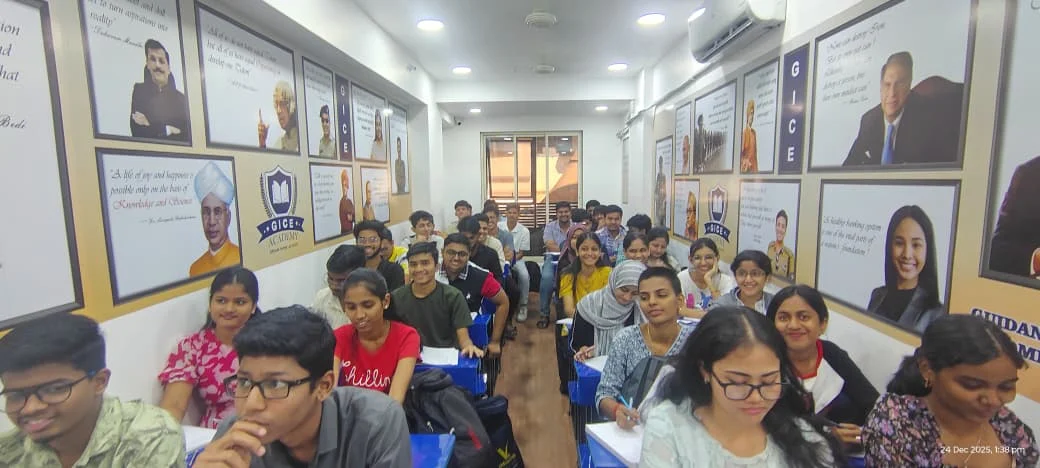
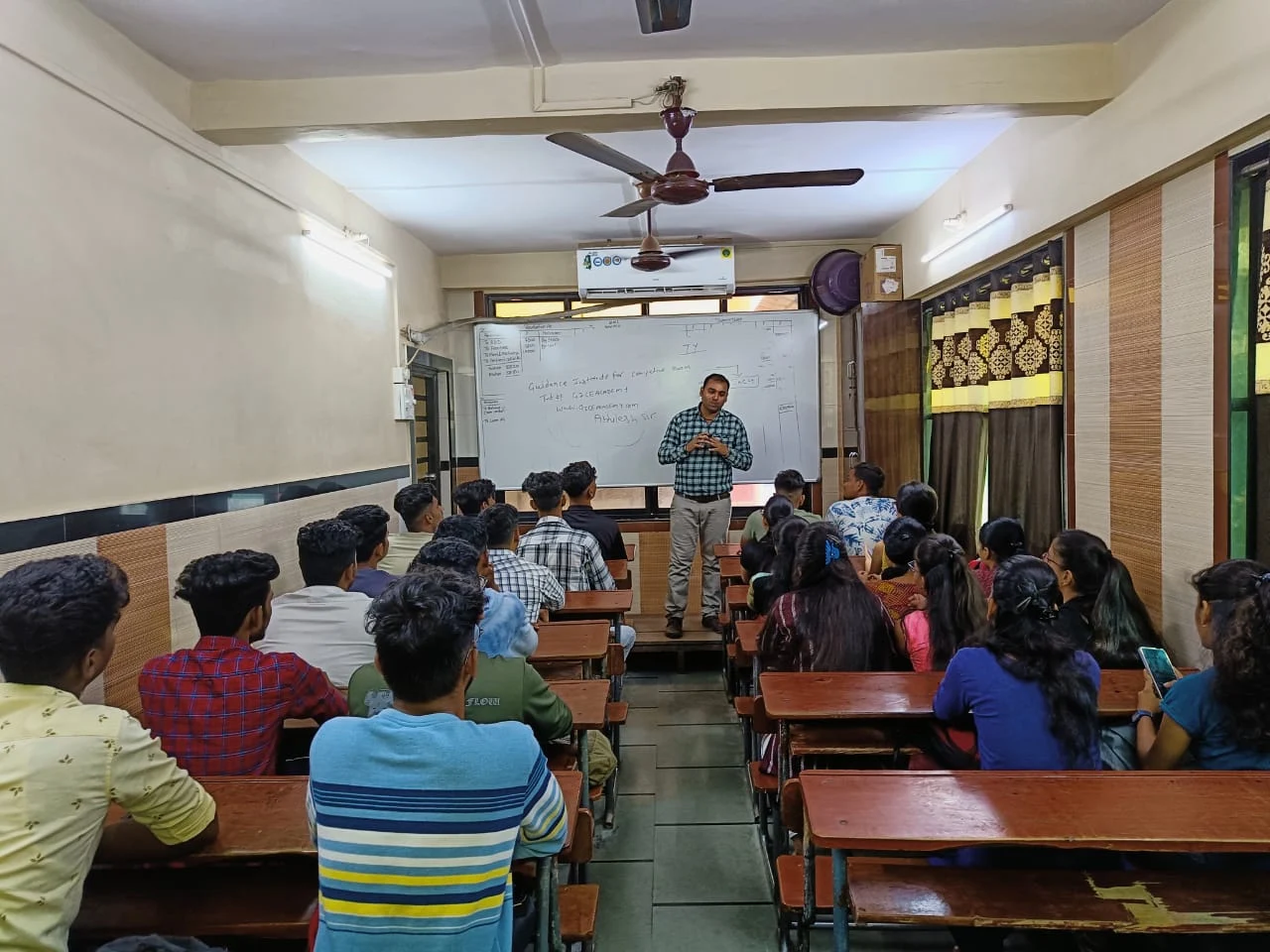
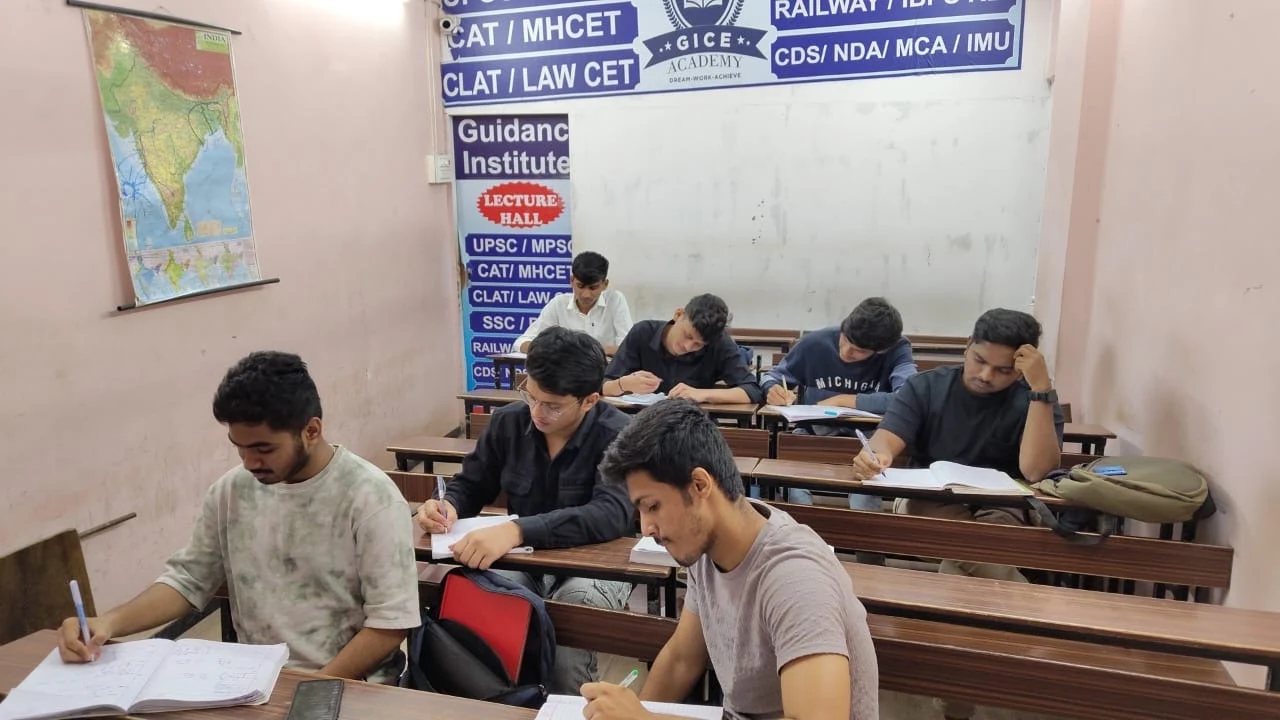
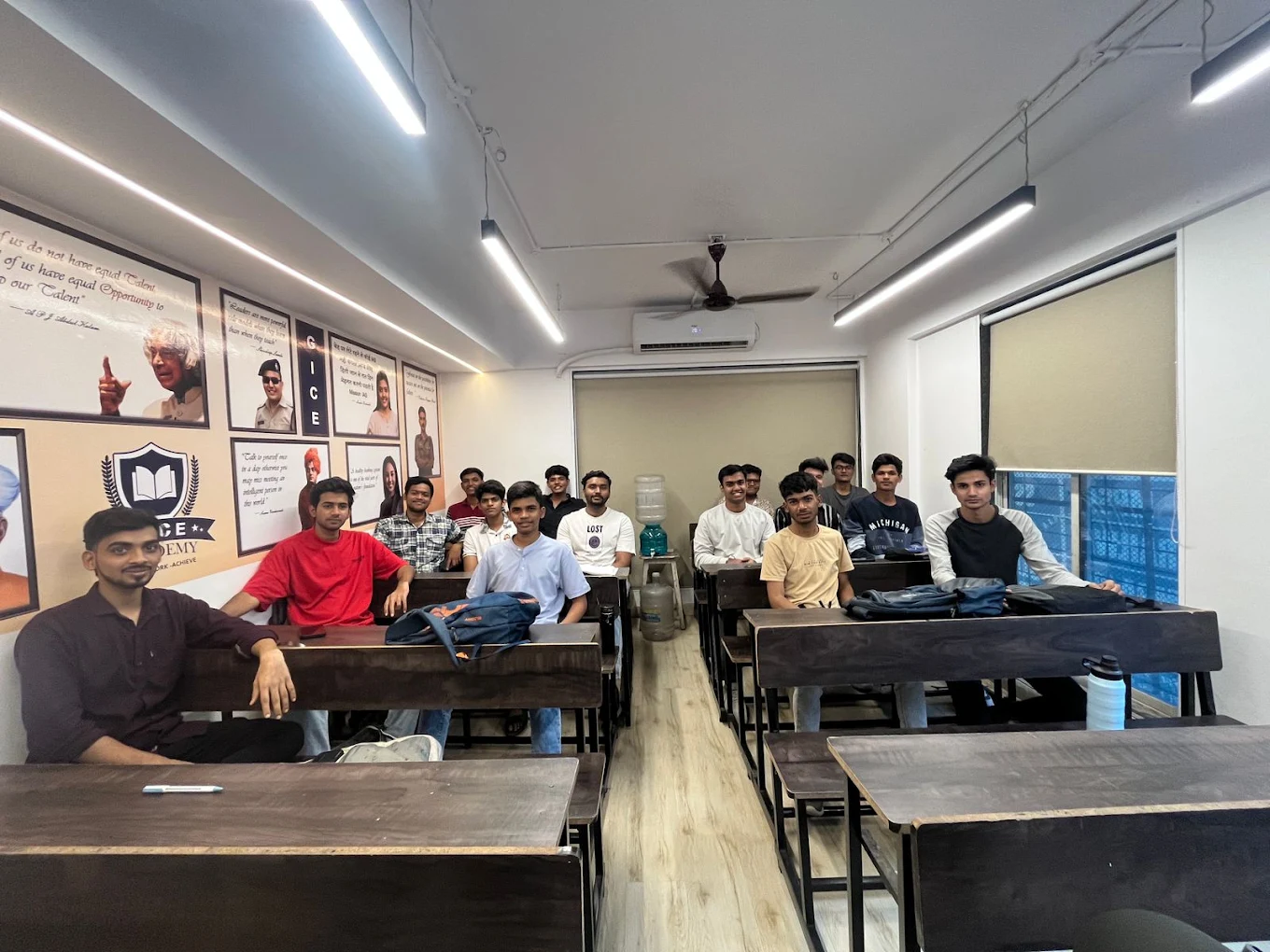
Explore the learning environment and classroom sessions at GICE Academy.

The NDA Entrance Exam, officially the NDA & NA Examination, is conducted by UPSC to select candidates for training at the National Defence Academy and the Indian Naval Academy.
Yes — students who have passed or are appearing in Class 12 are generally eligible, subject to meeting all other criteria in the current UPSC notification.
The written exam has two objective-type papers — Mathematics and the General Ability Test — both subject to negative marking. Exact marks and duration should be confirmed from the current notification.
Recent notifications have used an approximate window of 16.5 to 19.5 years as on the course-commencement date, with exact date-of-birth cut-offs specified separately for each cycle. Always confirm the current window from the official notification.
Written examination, SSB interview, medical examination, final merit-based selection, and training at the National Defence Academy.
Yes — topic-wise, sectional and full-length NDA mock tests, previous-year question practice, detailed performance analysis and early SSB awareness are built into the preparation journey alongside subject-wise classroom teaching.
[Your full address here — building, street, landmark, area, Thane, pincode]