
XAT (Xavier Aptitude Test) is a national-level management entrance examination conducted by XLRI Jamshedpur on behalf of XAMI (the Xavier Association of Management Institutes), used for admission to MBA/PGDM and related management programmes at XLRI and a large network of other participating business schools.
What sets XAT apart is its unique Decision Making section, along with a distinctive marking scheme and a General Knowledge component. Because the exam rewards genuine reasoning ability rather than rote learning, structured and well-guided preparation makes a real difference to how a candidate ultimately performs.
Our Dombivli centre supports XAT aspirants through strong concept building, guided practice, dedicated Decision Making preparation, realistic mock tests, detailed performance analysis, and consistent faculty guidance and mentorship, following a simple philosophy: Learn → Practise → Test → Analyse → Improve → Repeat.

Sections Incl. Decision Making & GK
Hours Total Exam Duration (Approx.)
Attempt Per Year — Conducted Every January
Flagship Institute Using XAT as Primary Entrance
XAT rewards genuine reasoning ability, particularly in its distinctive Decision Making section. Our Dombivli programme is built around the things that genuinely convert practice into a stronger percentile.
Decision Making is treated as its own distinct skill area, not an extension of logical reasoning — many students under-prepare for it, which is exactly where focused practice pays off.
Verbal Ability & Logical Reasoning, Decision Making, Quantitative Ability & DI, and General Knowledge are each built up from fundamentals before timed practice begins.
With XAT's negative marking and unattempted-question penalty in Part 1, we train disciplined question-selection strategy rather than blanket attempt-everything habits.
Since GK is factored into final selection by XLRI and other institutes, we keep current-affairs preparation running throughout the programme, not just before the exam.
XAT is organised into two parts: Part 1 combines three sections within a single overall time limit, and Part 2 is a separately timed General Knowledge section.
Around 26 questions covering reading comprehension, vocabulary, grammar, para jumbles and critical reasoning.
Around 21 questions of situational and case-based analytical decision-making — XAT's defining, most distinctive section.
Around 28 questions covering quantitative aptitude, data interpretation and analysis.
Around 20 questions on current affairs and static awareness, separately timed and not counted toward the shortlisting percentile in recent years, but factored into final selection.
Exact question counts, timing and marking rules can be revised year to year. Always verify current details on the official XAT website (xatonline.in) before finalising your preparation plan.
XAT eligibility criteria are set by XLRI Jamshedpur and are generally consistent year to year, though candidates should always confirm the latest official notification before applying.
A bachelor's degree of at least three years' duration (or equivalent) in any discipline from a recognised university. Candidates with certain professional qualifications (CA, CS, ICWA/CMA) are typically also eligible.
Candidates in their final year, or those awaiting final results, are generally also eligible, subject to submitting proof of degree completion by a specified deadline set by XLRI.
There is generally no upper or lower age limit specified for appearing in the XAT examination itself.
NRI, OCI and foreign national candidates seeking admission to XLRI's programmes are typically required to apply through GMAT (or, in some cases, GRE) scores rather than XAT.
Meeting XAT eligibility allows you to sit for the exam, but each institute may set its own additional academic requirements for final admission. Always verify current details on xatonline.in.
The XAT syllabus is organised broadly around four areas. Not every topic appears in every year's paper — these represent the major areas candidates should prepare for.
Reading comprehension (including varied and sometimes unconventional passage types), vocabulary and grammar, sentence correction and completion, para jumbles, critical reasoning and argument evaluation, and inference-based questions.
Situational judgement based on business or workplace scenarios, ethical decision-making, case-based and caselet-driven reasoning, analytical decision-making involving multiple variables, prioritisation of competing objectives, and structured evaluation of possible options.
The figures below are indicative of the recent-year XAT structure. Always verify the exact current-year structure on the official XAT website (xatonline.in) closer to your test date.
| Section | Approx. Questions | Major Areas |
|---|---|---|
| Verbal Ability & Logical Reasoning (Part 1) | ~26 | Reading comprehension, grammar, critical reasoning |
| Decision Making (Part 1) | ~21 | Situational & case-based analytical decision-making |
| Quantitative Ability & DI (Part 1) | ~28 | Quant aptitude, data interpretation |
| General Knowledge (Part 2) | ~20 | Current affairs, static GK — separately timed |
XLRI can revise the pattern, question counts, timing or marking scheme year to year. Always verify the latest official notification and exam-pattern page on xatonline.in before building a detailed preparation plan.
While each participating institute follows its own process, the general journey from XAT registration to MBA/PGDM admission typically follows these broad steps.
Register on xatonline.in
Conducted once a year, in January
Score & percentile declared
GD / WAT / PI, per institute
Decided by the individual institute
Preparation follows a consistent philosophy, with dedicated focus on Decision Making at every stage — Learn, Practise, Test, Analyse, Improve, Repeat.
Understanding your current level, target percentile, and target institutes.
Strong fundamentals across Verbal Ability, Decision Making, Quant & DI, and General Knowledge.
Dedicated caselet practice alongside sectional and full-length mock tests across all four sections.
Detailed performance analysis, mentorship, and a consolidated exam-day strategy for XLRI and beyond.
XAT itself does not directly provide a job. Career opportunities generally follow after completing an MBA/PGDM programme through XLRI or another XAT-accepting institute.
Roles in consulting, finance and banking following an MBA/PGDM specialisation.
Roles in marketing, human resources and business development.
Roles in business analytics, operations management and corporate strategy.
Roles in product management, technology management and general management tracks.
GICE Academy does not promise or predict specific salaries, placements or career outcomes. These depend on the institute, programme, individual profile and prevailing recruitment conditions.
Guidance Institute for Competitive Exams was founded in 2018 with a vision to provide effective and qualitative education for competitive examinations. Our strength lies in our dedicated and experienced faculty. GICE Academy has emerged as a leading competitive exam institute in Thane with a strong focus on student success.
Career With Us





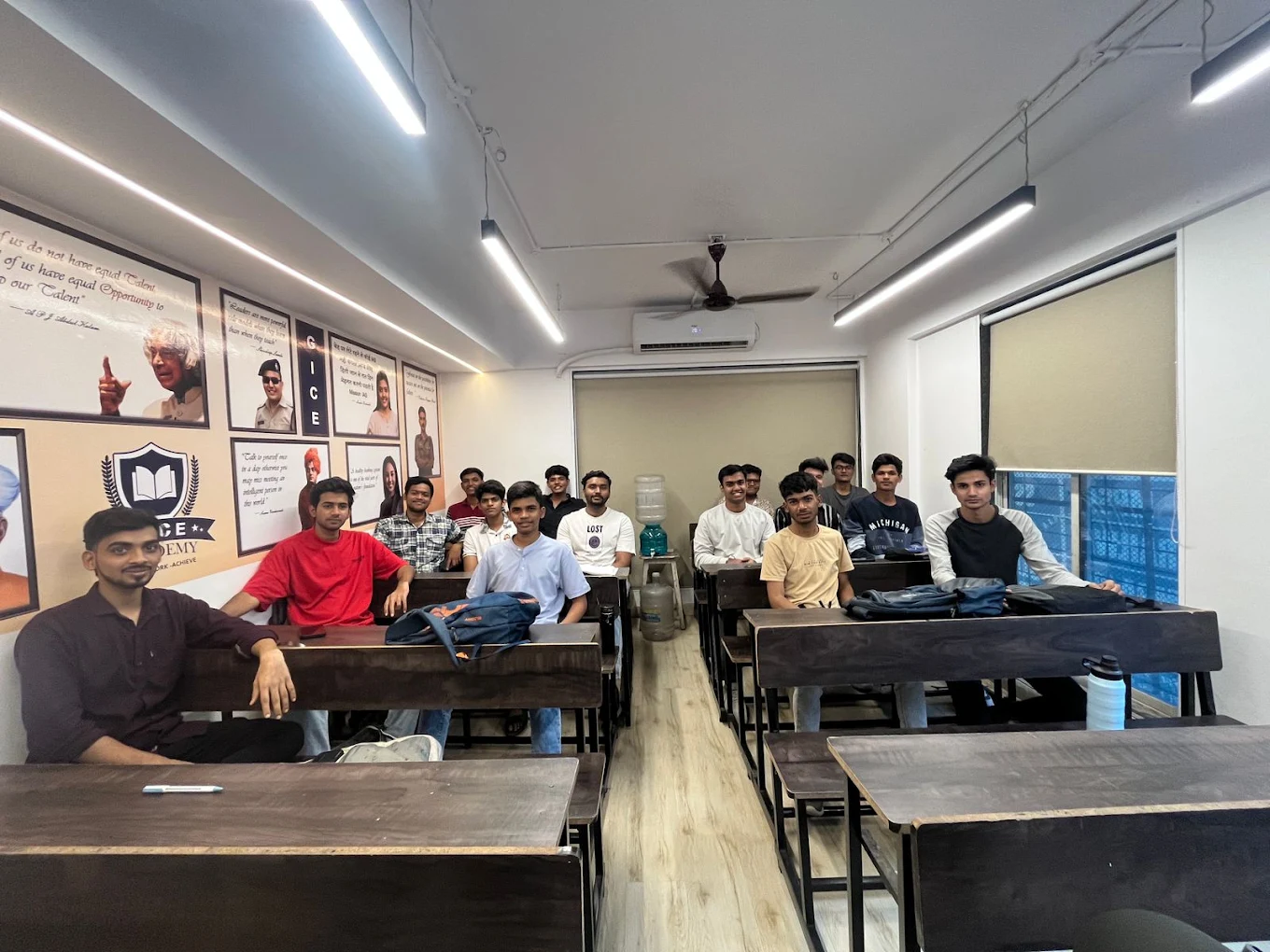
Explore the learning environment and classroom sessions at GICE Academy.




XAT (Xavier Aptitude Test) is a national-level management entrance examination conducted by XLRI Jamshedpur on behalf of XAMI, used for admission to XLRI and a wide network of other participating MBA/PGDM institutes.
XAT is a computer-based test with objective questions across four sections — Verbal Ability & Logical Reasoning, Decision Making, Quantitative Ability & DI, and a separately timed General Knowledge section — with negative marking.
Candidates generally need a bachelor's degree of at least three years' duration (or equivalent) in any discipline; final-year students are typically also eligible, subject to submitting proof of completion by a specified deadline.
Decision Making is a distinctive XAT section that evaluates how well candidates can reason through realistic business and ethical scenarios and choose the most appropriate course of action, rather than testing memorised formulas.
Yes, XAT is the primary entrance examination used by XLRI Jamshedpur for its flagship MBA/PGDM programmes, along with a wide network of other participating institutes across India.
Yes — sectional tests, topic tests, dedicated Decision Making caselet practice, and full-length mock tests across all sections, along with detailed performance analysis, are built into the preparation journey.
[Your full address here — building, street, landmark, area, Dombivli, pincode]