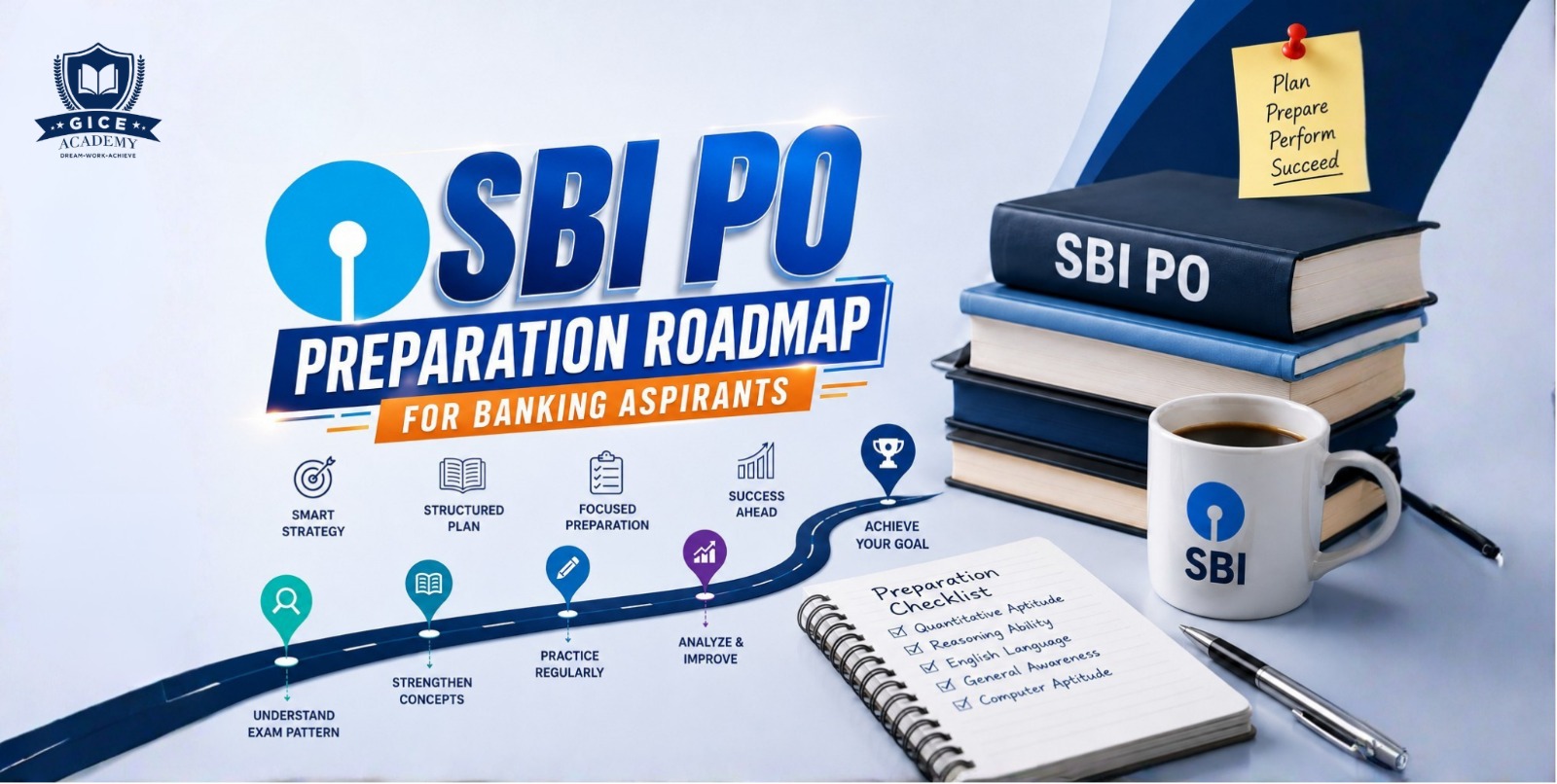

Every year, lakhs of graduates across India sit down with one goal in mind: cracking the SBI PO exam and securing a seat at India’s largest public sector bank. The dream is real, the competition is fierce, and the path is well-defined, but only if you know where to start.
This complete SBI PO preparation roadmap breaks down everything you need, from understanding the exam structure to building a daily study habit, picking the right books, and clearing the interview round. Whether you are starting from scratch or giving it another shot, this guide will help you build a plan that works.
What Is the SBI PO Exam and Why Does It Matter?
The State Bank of India Probationary Officer (SBI PO) exam is one of the most respected banking recruitment tests in India. It is conducted annually by SBI to select graduates for the role of Probationary Officer across its branches nationwide.
A few reasons why aspirants target this exam above others:
- Job security with one of India’s most trusted institutions
- Starting salary of approximately Rs. 52,000 to Rs. 55,000 per month (including allowances)
- Growth path from Probationary Officer to Branch Manager and beyond
- Prestige that comes with working at India’s largest public sector bank
The selection ratio is often below 1%, which makes smart preparation non-negotiable.
Understanding the SBI PO Exam Pattern
Before you open a single textbook, you must understand what the exam looks like. The SBI PO selection process has three main stages.
Phase 1: Preliminary Examination
The Prelims is a qualifying stage. Your marks here do not count in the final merit list, but you must clear the cutoff to move forward.
| Section | Questions | Marks | Time |
| English Language | 30 | 30 | 20 min |
| Quantitative Aptitude | 35 | 35 | 20 min |
| Reasoning Ability | 35 | 35 | 20 min |
| Total | 100 | 100 | 60 min |
Key update: There is no sectional cutoff in the SBI PO Prelims exam. You only need to clear the overall cutoff.
Phase 2: Mains Examination
The Mains exam carries more weight and covers a broader syllabus. It has two parts:
Objective Section:
| Section | Questions | Marks | Time |
| Reasoning and Computer Aptitude | 45 | 60 | 60 min |
| Data Analysis and Interpretation | 35 | 60 | 45 min |
| General/Economy/Banking Awareness | 40 | 40 | 35 min |
| English Language | 35 | 40 | 40 min |
| Total | 155 | 200 | 3 hrs |
Descriptive Section:
The Mains now includes Essay Writing, Letter Writing, Report Writing, and Precis Writing. This section tests your written communication skills in English.
Phase 3: Group Discussion and Personal Interview
- Group Discussion: 20 marks
- Personal Interview: 30 marks
- New addition: SBI has introduced a Psychometric Test in Phase 3 for personality profiling. It is not scored but plays a role in the selection process.
The final merit list is based on Mains marks (objective + descriptive) and the Interview round combined.
SBI PO Syllabus: Section-Wise Breakdown
A thorough understanding of the syllabus helps you avoid studying irrelevant topics and focus your energy where it counts.
English Language
Prelims topics:
- Reading Comprehension
- Cloze Test
- Para Jumbles
- Fill in the Blanks
- Error Detection
- Sentence Correction
Mains additions:
- Para Summary
- Inference-based questions
- Vocabulary-heavy comprehension passages
Quantitative Aptitude (Prelims) / Data Analysis and Interpretation (Mains)
Prelims topics:
- Simplification and Approximation
- Quadratic Equations
- Number Series
- Data Interpretation (DI): Bar graphs, Pie charts, Tables, Line graphs
- Arithmetic: Percentage, Profit and Loss, Time and Work, Speed-Distance, Average, Ratio
Mains: The focus shifts almost entirely to DI in complex formats, including caselet-based DI and mixed graphs.
Reasoning Ability
- Puzzles and Seating Arrangement (highest weightage)
- Syllogisms
- Blood Relations
- Direction Sense
- Coding-Decoding
- Inequalities
- Input-Output
General/Economy/Banking Awareness
- Current Affairs (last 4 to 6 months)
- Banking and Financial Awareness
- Indian Economy basics
- Government schemes
- RBI policies and news
Computer Aptitude (Mains only)
- Computer Basics
- MS Office
- Internet and Networking
- Number Systems
- Shortcuts and Functions
Step-by-Step SBI PO Preparation Strategy
Knowing the syllabus is step one. Knowing how to attack it is step two.
Step 1: Start With the Syllabus and Exam Pattern
This is not optional. Many aspirants skip this step and end up studying the wrong topics. Download the official SBI PO notification and go through the syllabus in full before you study a single topic.
Mark which sections you are already comfortable with and which ones need more attention.
Step 2: Build a Realistic Study Schedule
A 60-day study plan works well for most aspirants. Here is a sample framework:
Days 1 to 20: Concept Building
- Study one topic per subject each day
- Focus on Quantitative Aptitude basics and Reasoning concepts
- Read English newspapers for 30 minutes daily (The Hindu, The Economic Times)
- Start a daily current affairs habit from day one
Days 21 to 40: Practice and Speed Building
- Move from concept mode to practice mode
- Attempt 50 to 60 questions daily across all Prelims sections
- Start topic-wise mini mock tests
- Note down mistakes and shortcuts in a revision notebook
Days 41 to 55: Mock Test Phase
- Attempt at least 2 to 3 full-length Prelims mocks per week
- Analyze every mock: check score, accuracy, time taken, and topics where you lost marks
- Solve previous years’ papers to understand question patterns
Days 56 to 60: Final Revision
- Focus only on revision, not new topics
- Go through your mistake notebook
- Take one full mock daily
- Revise Banking Awareness and Current Affairs
Step 3: Prepare for Prelims and Mains Simultaneously
Many aspirants make the mistake of focusing only on Prelims. The wiser approach is to cover both syllabi from the start. Topics like Data Interpretation and English comprehension are relevant to both phases, so studying them in depth early saves time later.
Subject-Wise Preparation Tips
How to Prepare for Quantitative Aptitude
This is the toughest section for most aspirants. Speed and accuracy together decide your score here.
- Start with Arithmetic topics: Percentage, Ratio, Profit-Loss, Time-Work, and Average
- Learn shortcut methods for quick calculations
- Practise Simplification daily to improve calculation speed
- For DI, learn to read graphs fast and calculate percentages without a calculator
- Do not ignore Number Series and Quadratic Equations, as they are quick marks if practised well
How to Prepare Reasoning Ability
Puzzles and Seating Arrangements dominate both Prelims and Mains. Investing time here pays off well.
- Practise at least 5 to 7 puzzles every day
- Learn to identify the puzzle type quickly: linear, circular, floor-based, or multi-variable
- Syllogisms, Inequalities, and Direction Sense are scoring if you know the rules
- Time management is key: if a puzzle takes more than 5 minutes, move on
How to Prepare English Language
This section is often underestimated. A strong foundation in English helps in both the objective and descriptive tests.
- Read one editorial from The Hindu or The Economic Times every day
- Build vocabulary using Word Power Made Easy by Norman Lewis
- Practise Reading Comprehension daily with a timer
- For the Descriptive Test, practise writing one essay or letter every week and review it for grammar, structure, and coherence
How to Prepare for General and Banking Awareness
This section can be a great scoring area if prepared consistently.
- Spend 30 minutes every day on current affairs
- Use apps or monthly PDF digests to stay updated
- Focus on RBI announcements, government banking schemes, budget highlights, and financial news
- Revise static banking awareness topics like banking terminology, financial institutions, and RBI functions
Best Books for SBI PO Preparation
Choosing the right books saves time and keeps your preparation focused. Here are trusted options used by successful aspirants:
| Subject | Recommended Book |
| Quantitative Aptitude | Quantitative Aptitude for Competitive Examinations by R.S. Aggarwal |
| Reasoning Ability | Analytical Reasoning by M.K. Pandey; A Modern Approach to Verbal and Non-Verbal Reasoning by R.S. Aggarwal |
| English Language | High School English Grammar and Composition by Wren and Martin; Word Power Made Easy by Norman Lewis; Objective General English by S.P. Bakshi |
| Banking Awareness | Banking Awareness by RPH Editorial Board |
| All-in-One Guide | Comprehensive Guide to SBI Bank PO Preliminary and Mains Exam by Disha Experts |
| Previous Year Papers | Solved Papers 2005 to 2023 by GK Publications |
The Role of Mock Tests in SBI PO Preparation
Mock tests are where your preparation either comes together or falls apart. Taking mocks without analyzing them is a waste of time.
Here is how to use mock tests effectively:
- Start topic-wise mocks after finishing each topic
- Move to sectional mocks once you have covered all topics in a section
- Attempt full-length Prelims mocks timed at exactly 60 minutes
- After every mock, spend equal time on analysis: check which questions you got wrong, which ones took too long, and which you skipped
- Track your score over multiple mocks to spot trends in improvement or weak spots
Platforms like Embibe, PracticeMock, Testbook, and Adda247 offer mock test series tailored to the SBI PO exam pattern.
How to Prepare for the SBI PO Descriptive Test
The Descriptive Test is a section many aspirants neglect until the last minute. That is a mistake.
What it covers:
- Essay Writing
- Letter Writing
- Report Writing
- Precis Writing
How to prepare:
- Pick two to three topics from current affairs every week and write short essays on them
- Practise formal and informal letter formats
- Learn the structure of a report: heading, date, introduction, findings, and conclusion
- Aim for clear, grammatically correct writing. Examiners value clarity over complexity
Set a timer when you practise. You will have limited time in the actual exam.
How to Prepare for the GD and Interview Round
Making it to the GD and Interview stage is an achievement. But the competition here is just as real.
Group Discussion Tips
- Read broadly: economics, current events, banking reforms, and social issues
- Practise speaking clearly and confidently, not just loudly
- Listen to other participants and build on their points
- Avoid interrupting others and stick to facts
Personal Interview Tips
- Review your resume thoroughly. Be ready to explain everything you have mentioned
- Know basic banking concepts: types of accounts, RBI functions, repo rate, NEFT, RTGS
- Stay updated on recent banking news and government schemes
- Be honest. If you do not know something, say so rather than guessing
Psychometric Test
While the Psychometric Test is not scored, it assesses personality traits that SBI considers relevant for the role. Answer honestly and consistently. Inconsistent responses can raise flags in the assessment.
Common Mistakes to Avoid During SBI PO Preparation
Even hard-working aspirants make avoidable errors. Watch out for these:
- Studying without a plan: Random study wastes time. Always follow a schedule.
- Ignoring weak areas: It is tempting to keep practising what you are already good at. Spend more time on weak sections.
- Skipping mock analysis: Taking mocks and not reviewing mistakes means you repeat the same errors.
- Neglecting current affairs: This section is easy to score in but only if prepared consistently over months.
- Not practising the Descriptive Test: Many candidates lose marks here simply because they never practised writing under time constraints.
- Burning out: Studying 14 hours a day is not sustainable. Six to eight quality hours are more effective than exhausted marathon sessions.
SBI PO Preparation for Working Professionals
If you have a job while preparing, the strategy needs some adjustment:
- Mornings are gold: Study for 1.5 to 2 hours before work when your mind is fresh
- Lunch breaks count: Use 20 to 30 minutes for current affairs or quick topic revision
- Weekends are intensive: Keep weekends for longer study sessions and full-length mocks
- Use commute time: Listen to banking awareness podcasts or review flashcards
- Aim for at least four to five focused hours daily across morning, evening, and weekend slots
Can You Crack SBI PO Without Coaching?
Yes. Many successful SBI PO officers cracked the exam without any formal coaching. What you need is:
- A clear study plan
- The right books and study material
- A good mock test series with analysis tools
- Consistency and daily practice
- Access to current affairs resources
Online platforms like Embibe, Adda247, and PracticeMock provide structured video courses, e-books, and mock test series that can replace classroom coaching for disciplined self-learners.
Key Takeaways
- The SBI PO exam has three stages: Prelims, Mains, and GD/Interview. Each stage requires a different preparation focus.
- There is no sectional cutoff in Prelims. Your goal is to clear the overall cutoff.
- Mains marks and Interview marks together decide your final rank.
- Start Prelims and Mains preparation simultaneously from day one.
- Mock tests with deep analysis are the single most effective tool in your preparation.
- Current affairs should be a daily habit, not last-minute cramming.
- The Descriptive Test and Psychometric Test are newer additions. Do not ignore them.
- You do not need coaching to crack SBI PO. A solid plan and consistent effort are enough.
Conclusion
The SBI PO exam is tough, but it is absolutely crackable with the right preparation mindset. The aspirants who succeed are not necessarily the most talented. They are the ones who started early, stayed consistent, used mock tests wisely, and kept improving week after week.
Pick up the syllabus today, build your study plan, and start. The effort you put in over the next few months will determine where your career goes from here. The seat is available. The question is whether your preparation will earn it.
Start smart. Stay consistent. Clear the exam.