
Getting a job in the Indian public sector is tough. The fight for financial jobs is getting fiercer by the day. You need a structured roadmap to beat the odds.
Good bank exam preparation means knowing your stuff well and sticking to a plan. Start with clear goals to turn your study time into a winning plan. This guide is your first step to a career in finance.
Whether you’re new or want to get better, staying disciplined is key. Proper bank exam preparation keeps you on top and helps you reach your goals with confidence.
Key Takeaways
- Understand the evolving landscape of public sector recruitment for 2026.
- Prioritize a structured study plan to manage your time efficiently.
- Focus on mastering core subjects to build a strong conceptual base.
- Maintain consistency to stay competitive in a high-pressure environment.
- Utilize foundational resources to streamline your learning process.
The Evolving Landscape of Indian Banking Exams in 2026
Big names like SBI and IBPS are changing how they pick candidates. They want people who can think deeply, not just memorize facts. As you get ready for the IBPS exam 2026, know these changes are to find the best for the future.
The banking exam syllabus 2026 now focuses on solving problems with tech and thinking clearly. Test-takers must handle big data and digital tools fast. This makes sure they can keep up with today’s banking needs.
It’s key to understand these changes to do well. The banking exam syllabus 2026 is more than just topics. It shows what skills are needed in today’s banking world. By studying in line with these changes, you’ll stand out more than those who don’t.
The table below shows the big changes in what’s tested for the IBPS exam 2026:
| Evaluation Metric | Traditional Approach | Modern 2026 Standard |
| Problem Solving | Formula-based | Analytical/Logical |
| Digital Literacy | Basic Awareness | System Integration |
| Data Handling | Manual Calculation | Tech-Driven Interpretation |
| Decision Making | Standardized Logic | Situational Judgment |
Strategic Framework for Effective Bank Exam Preparation
Mastering banking exams is not just about hard work. It needs a strategic roadmap. A good plan helps you tackle SBI PO preparation and RBI Grade B strategy well. Focus on key topics to boost your skills and confidence.
Good bank exam preparation means sorting subjects by importance and your skill level. Spend more time on tough areas and keep practicing in your strengths. This way, you cover all bases in your study routine.
The table below shows how to focus on key areas for better exam scores.
| Subject Area | Priority Level | Focus Strategy |
| Quantitative Aptitude | High | Speed and Accuracy |
| Reasoning Ability | High | Logical Deduction |
| General Awareness | Medium | Daily Current Affairs |
| English Language | Medium | Reading Comprehension |
This approach makes your bank exam preparation more focused. It’s vital for both SBI PO preparation and RBI Grade B strategy. Stick to your plan, and you’ll see your mock test scores improve.
Case Study: Analyzing the Success Path of a Top Ranker
Looking at a top ranker’s path shows us how to master exams. They don’t just get lucky; they follow a disciplined framework. This framework focuses on knowing yourself well. By studying these high achievers, we learn the habits that lead to competitive exam success.
Identifying Core Strengths and Weaknesses
The first step is to honestly check where you stand. Top performers start by figuring out their strong and weak areas. They then spend more time on tough subjects and keep their strong areas sharp.
By focusing on their weaknesses, students make a personalized study plan. This plan helps them avoid wasting time. It means studying in a way that really helps them score higher. It’s the smart way to study, not just hard.
The Role of Consistent Mock Test Analysis
Using practice exams is key to success. But, just taking the test isn’t enough for competitive exam success. The real value is in reviewing the test afterwards. This helps them avoid making the same mistakes again.
Good mock test analysis breaks down mistakes into types. This helps them improve their speed and accuracy. The table below shows how a top ranker improves by focusing on these areas.
| Analysis Metric | Focus Area | Action Taken |
| Conceptual Gap | Weak Topics | Re-read core textbooks |
| Speed Constraint | Calculation Heavy | Practice mental math |
| Accuracy Rate | Logical Reasoning | Review shortcut methods |
| Time Management | Full-length Tests | Simulate exam conditions |
Keeping track of these details helps students see their progress. Regular mock test analysis turns data into useful insights. This ensures each practice session moves them closer to their goal.
Mastering Quantitative Aptitude and Data Interpretation
Improving your performance in exams is possible with better problem-solving skills. Success in banking exams depends on quick and accurate data handling. Use quantitative aptitude tips to make this section your strong point.
Advanced Problem-Solving Techniques
Going beyond simple formulas is key to success. Use mental math shortcuts and approximations to solve problems fast. This way, you can tackle complex math quickly.
Practice modular arithmetic and algebraic identities to improve your thinking. Knowing problem patterns helps you solve them faster. This is the core of data interpretation tricks.
Time Management Strategies for Calculation-Heavy Sections
Good time management is vital to complete the exam. Focus on easy questions first, then move to harder ones. Always look for quick answers in the section.
Use a methodical approach to data sets to find what you need quickly. The table below shows how to manage your time better during the exam.
| Methodology | Traditional Approach | Optimized Strategy |
| Arithmetic | Step-by-step manual solving | Mental estimation and unit digit analysis |
| Data Sets | Reading every value in the chart | Targeted extraction based on question needs |
| Time Allocation | Solving in sequential order | Prioritizing high-weightage, easy topics |
| Accuracy | Double-checking every calculation | Using reverse verification for speed |
By using these data interpretation tricks daily, you’ll get better at exams. Remember, quantitative aptitude tips work best with regular practice. Focus on being accurate, and your speed will improve.
Developing Proficiency in Reasoning and Logical Ability
Reasoning ability practice is key for anyone aiming to be a bank officer in India. It tests your quick thinking and ability to handle information under stress. Mastering these skills can give you an edge over others who struggle with time.
Decoding Complex Puzzle Patterns
Many students get stuck on long, complicated puzzles. To do well, break these problems down into smaller parts. Start by finding the fixed parts of the puzzle before linking the rest.
Look for the “anchor” information in puzzles. This is the key data that sets the puzzle’s direction. Once you find these anchors, solving the rest becomes much faster.
Logical Deduction and Critical Thinking Exercises
Regular practice is vital for improving your deductive skills. Try solving puzzles every day to sharpen your mind. This builds the mental strength needed for tough exam questions.
Critical thinking is about finding answers quickly and efficiently. By solving puzzles often, you learn to spot patterns fast. This helps you skip unnecessary steps and focus on the puzzle’s core.
| Reasoning Topic | Difficulty Level | Key Strategy |
| Linear Seating Arrangement | Moderate | Identify fixed positions first |
| Circular Puzzles | High | Use internal/external orientation |
| Syllogisms | Low to Moderate | Apply Venn diagram methods |
| Data Sufficiency | High | Evaluate statements independently |
Your goal is to keep a steady pace during the test. Don’t let a tough question slow you down. If a puzzle is too hard, mark it and move on to get the most points.
English Language Mastery for Competitive Banking
Mastering English for banking is more than just knowing words. It’s about understanding how sentences work. Many find this part hard, but it’s key to doing well. With regular practice, you can make this section your strongest.
Building Vocabulary and Reading Comprehension
To do well, use reading comprehension techniques to get info fast. Read editorials every day to get better at quick reading. Active reading helps you catch the main point without getting lost.
Building your vocabulary should be a daily task, not a rush job. Use flashcards or apps to learn words in context. Try to use new words in sentences to remember them better.
Grammar Rules and Error Detection Tactics
Knowing English grammar for banking well is key for spotting errors. Focus on common topics like verb agreement and tense. These are often tested and can affect your score.
Having a plan for finding errors can save time. Always read the whole sentence first. Then, look for common mistakes like wrong modifiers or pronouns.
| Error Category | Common Pitfall | Detection Strategy |
| Subject-Verb Agreement | Ignoring singular/plural nouns | Identify the main subject first |
| Tense Consistency | Mixing past and present | Check the time markers in the sentence |
| Preposition Usage | Incorrect fixed prepositions | Memorize common phrase pairings |
| Modifier Placement | Ambiguous descriptions | Ensure adjectives are near the noun |
By using these analytical tactics regularly, you’ll get better at spotting errors. Remember, practice is key to feeling confident on the exam. Stay focused, and your hard work will show in your scores.
General Awareness and Financial Literacy Integration
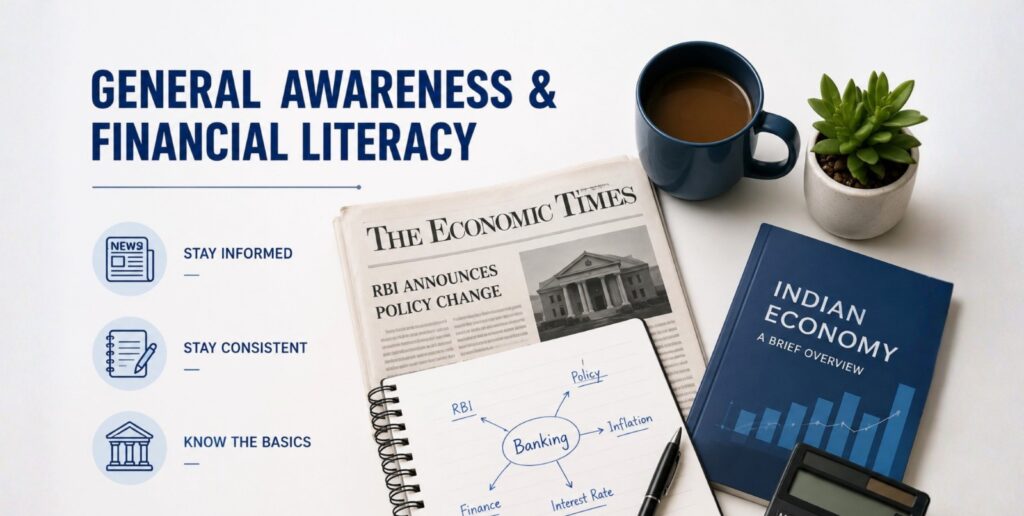
Knowing about financial news is key for bank exams. This financial awareness guide helps you understand economics and rules. Being up-to-date gives you an edge over others.
Tracking Current Affairs and Banking News
Staying consistent is important for current affairs for bank exams. Spend at least an hour each day reading The Hindu or The Economic Times. Look for policy changes, RBI news, and banking appointments.
Here are some tips to help you remember:
- Keep a notebook for daily notes.
- Use apps for news updates.
- Check your notes every weekend.
Static GK and Financial Terminology Essentials
Learn the basics that don’t change. Questions often cover banking history, international groups, and financial terms. Knowing these well helps you avoid losing points.
Here’s what to focus on for your studies:
| Category | Key Focus Area | Importance |
| Banking Terms | Repo Rate, CRR, SLR | High |
| Organizations | RBI, SEBI, NABARD | High |
| Static GK | National Parks, Dams, Capitals | Medium |
Financial literacy is more than just remembering facts. It’s about understanding how things work together. Connect static knowledge with current events. This way, you’ll get a better score in General Awareness.
Designing a Personalized 2026 Study Schedule
Creating a study schedule for competitive exams is key to managing your time. It helps you cover the whole syllabus. A strict plan can cause burnout, but a flexible one fits your learning pace and daily life.
Studying when you’re most focused helps you learn better. This way, you can retain more and stay focused longer.
Balancing Subject-Wise Daily Targets
Spreading your effort evenly across subjects is important. Consistency helps you grasp tough topics like Quantitative Aptitude or Reasoning. Set aside specific times for each subject based on how well you know it.
For example, tackle Data Interpretation in the morning when you’re most alert. Use the afternoon for easier tasks like vocabulary or current events. This balanced study schedule for competitive exams helps you improve in all areas of the banking syllabus.
Weekly Revision and Performance Review Cycles
Weekly reviews are vital for success. Every Sunday, check how you did against your weekly goals. This helps you spot knowledge gaps and adjust your study schedule for competitive exams as needed.
Include a full mock test in your weekly routine to get used to the exam format. Reviewing your mistakes right after the test is crucial for long-term improvement. Use the table below to organize your weekly study effectively.
| Day of Week | Primary Focus | Revision Task |
| Monday – Wednesday | Quantitative & Reasoning | Concept Review |
| Thursday – Friday | English & General Awareness | Vocabulary Drills |
| Saturday | Full Mock Test | Error Analysis |
| Sunday | Weak Area Focus | Planning Next Week |
Leveraging Digital Resources and Coaching Platforms
The digital world has changed how students get ready for banking exams in India. Online coaching for banking helps you move from basic to advanced knowledge. It offers a structured plan, which self-study often lacks.
Selecting High-Quality Study Materials
Finding the right study materials is key to success. Make sure they match the latest exam patterns and levels. Top online coaching for banking sites offer updated mock tests and detailed PDFs.
Look for these in study materials:
- Pattern Alignment: Does it match the latest syllabus?
- Difficulty Scaling: Are there questions for all skill levels?
- Expert Pedagogy: Are the video lessons clear?
Here’s a comparison of self-study and digital coaching:
| Feature | Self-Study | Online Coaching |
| Resource Curation | Manual/Time-consuming | Expert-curated |
| Doubt Resolution | Limited/Slow | Instant/Community-based |
| Exam Strategy | Trial and Error | Proven Frameworks |
Utilizing Online Communities and Peer Learning
Preparation can feel lonely, but it doesn’t have to be. Online communities let you share insights and stay motivated. Peer learning helps you discuss tough topics and find shortcuts.
Joining forums or study groups helps you find your weak spots. Explaining a concept to someone else makes you understand it better. Using online coaching for banking communities keeps you up-to-date on exam news and banking trends.
Overcoming Common Psychological Barriers and Exam Anxiety
Getting ready for banking exams is like running a marathon with a moving finish line. The stress can make you feel very tired. It’s key to manage your exam anxiety well.
Remember, your mental health is as important as your studies. This is the first step to success.
Maintaining Motivation During Long Preparation Cycles
Staying motivated for months is not easy. You’ll have days when you feel like you’re not getting anywhere. This is normal.
To fight this, break your study plan into small, daily goals. This will make you feel accomplished.
Don’t forget to celebrate your small victories. This keeps your motivation up. When you’re feeling down, think about your long-term career goals in banking. This helps you stay focused, even when things get tough.
Stress Management Techniques for Exam Day
On exam day, staying calm is key. Use proven exam anxiety management strategies to keep your cool. Start with deep breathing to calm down if you feel stressed.
Also, plan your time wisely. If a question is too hard, don’t let it upset you. Just move on and come back to it later. This way, you show your true skills, not just your nerves.
Remember, your worth is not just in one test score. Keep things in perspective. This helps you stay calm and focused. Regular practice will make you better at managing your exam anxiety.
Post-Exam Analysis and Interview Preparation
After the first results, focus on understanding concepts deeply. The first test checks your speed and accuracy. But the main test looks at solving complex problems. Success at this level requires a shift in mindset.
Transitioning from Prelims to Mains Strategy
Move from quick fixes to really learning core ideas. The mains test includes writing and data analysis that need deep thinking. Full-length mock tests help get used to the real exam’s pressure.
Look at your mock test results to find what you don’t know. Don’t just look at scores, but why you got answers wrong. This way, you learn the subject, not just memorize.
Developing Communication Skills for Banking Interviews
Scoring well in the written test is just the start. To really stand out, work on your interview skills. Confidence is the bridge between a good candidate and a selected officer.
In the interview, speaking clearly is as key as knowing your stuff. Here are some tips to help:
- Maintain steady eye contact to show confidence and honesty.
- Practice listening well to answer questions directly.
- Work on your body language to look professional.
- Prepare clear, structured answers for common questions.
- Keep up with banking news to show your interest.
By using these interview preparation tips, you’ll show you’re a complete candidate. Interviewers want clear, honest, and professional answers. Practice with a mirror or friends to improve your speaking and feel more at ease.
Conclusion
To succeed in the 2026 recruitment cycle, you need more than hard work. You must have a clear vision and follow the roadmap in this guide.
Your banking career journey starts with daily use of these strategies. Every mock test and mastered concept moves you closer to your dream job at places like State Bank of India or HDFC Bank.
Keep your eyes on your long-term goals. Also, stay strong mentally to handle tough situations. Consistent effort is key to your success.
Contact Us to start your preparing today by setting achievable goals. Your hard work will pave the way for your banking career success next year. Share your progress with friends on sites like Oliveboard or Adda247 to stay motivated.