

Many graduates dream of working in India’s financial sector. But, the journey is filled with too much to study and lots of competition. Using random study materials often leads to burnout, not progress.
A Bank Exam Course from professionals gives you the clear path you need. It turns your study time into a focused plan. This way, every study hour helps you learn the syllabus better.
Being efficient is key to beating other candidates. A structured Bank Exam Course gives you the best study materials. It boosts your confidence and sharpens your focus. This increases your chances of getting into top institutions.
Key Takeaways
- Structured learning paths eliminate the confusion of self-study.
- Systematic syllabus coverage ensures no critical topics are missed.
- Focused preparation maximizes study efficiency and time management.
- Curated resources help candidates prioritize high-yield subjects.
- A professional approach provides a competitive edge in recruitment.
The Competitive Landscape of Indian Banking Examinations
The path to a career in Indian banking is filled with intense competition. Every year, millions try for a few spots in public sector banks. This makes banking exam preparation very tough for many.
Big names like the Institute of Banking Personnel Selection (IBPS) and the State Bank of India (SBI) handle these tests. The syllabus is huge, and the rules are strict. So, many students get help from competitive exam coaching to stand out. This coaching helps them understand the complex tests.
Knowing the challenge is the first step to a robust and effective strategy. Without a plan, it’s easy to get overwhelmed by all the study materials. Here’s a table that shows the main differences between major banking recruitment bodies. It can help you plan your path.
| Exam Body | Primary Focus | Difficulty Level | Selection Stages |
| IBPS PO | Management Roles | High | 3 Stages |
| SBI Clerk | Clerical Roles | Moderate | 2 Stages |
| IBPS RRB | Regional Banking | Moderate | 2 Stages |
| RBI Grade B | Regulatory Roles | Very High | 3 Stages |
To succeed in these exams, you need consistent effort and a good grasp of current trends. Using competitive exam coaching can help you focus on the most important topics. Good banking exam preparation keeps you ahead in this tough field.
Why Self-Study Often Falls Short for Competitive Exams

Self-study might seem cheap, but it often leaves big gaps in your knowledge. Many start their banking exam preparation with big dreams. But soon, they get lost in too much unorganized info.
Without a clear plan, it’s easy to get sidetracked. You might focus on topics that rarely show up on the test.
Studying alone means missing out on a curated curriculum. You often use old materials that don’t match today’s banking trends. This makes your hard work less effective.
Professional competitive exam coaching fills this gap. It gives you a clear path to follow. This way, every study hour counts towards your success.
Here are some common problems with studying alone:
- Inconsistent study patterns that lead to burnout.
- It’s hard to know which topics are most important.
- You miss out on real-time feedback and comparing with others.
- Old textbooks are used instead of modern digital tools.
Going from a casual learner to a top candidate takes more than books. Structured mentorship is key. It helps you tackle the syllabus with confidence. Investing in competitive exam coaching is about getting a strategic edge in your banking exam preparation.
Core Components of a High-Quality Bank Exam Course
A top-notch Bank Exam Course is key to your career. It breaks down hard topics into easy parts. This helps you stay focused on your goals.
Success in Indian banking needs discipline and the right tools. A good course gives you both.
Curriculum Design and Syllabus Coverage
Good prep starts with a full Banking syllabus coverage. A solid program covers all topics deeply. Look for courses that match the latest Banking exam syllabus.
A well-planned curriculum saves time. It lets you track your progress in each subject. Here are key parts of a good study plan:
- Detailed breakdown of core banking concepts.
- Regular updates based on recent exam patterns.
- Integration of practice sets for every module.
Learning from experts is a big plus. They make hard topics easy and share proven strategies. You can ask them questions right away.
Mentorship is more than teaching. It guides your career and keeps you motivated. A good support system helps you stay on track, even when it’s tough.
The table below shows the difference between studying alone and with a guide.
| Feature | Self-Study | Guided Course |
| Doubt Resolution | Limited | Immediate |
| Study Material | Scattered | Curated |
| Progress Tracking | Manual | Automated |
Adaptive Learning Technologies
Modern Online bank exam classes use smart tech. They tailor your learning to fit you. This makes you better faster.
This data-driven approach makes your study time count. You spend less time on easy topics. More time on hard ones. This gets you ready for the exam.
Developing a Disciplined Study Routine
Success in banking exams needs more than smarts; it needs a strict disciplined approach. A steady study routine for exams is key to your prep. Without a plan, even the most eager students can lose focus during SBI PO preparation.
Time Management Techniques for Working Professionals
Working full-time and studying hard needs top-notch exam time management. Many use the “early bird” method. They study two hours on tough topics before work.
Use lunch breaks or commutes for micro-learning. Apps or flashcards help with vocabulary or news. This way, you keep up without feeling too stressed.
Balancing Quantitative Aptitude and Reasoning
Good exam time management means switching subjects to keep your mind sharp. Spending all day on one subject can make you tired. Mix Quantitative Aptitude with Reasoning to keep your brain balanced.
Here’s a weekly plan to help you improve in all areas of SBI PO preparation.
| Focus Area | Time Allocation | Primary Goal |
| Quantitative Aptitude | 40% of Weekly Time | Mastering speed and accuracy |
| Logical Reasoning | 35% of Weekly Time | Solving complex puzzles |
| General Awareness | 25% of Weekly Time | Daily news and policy updates |
A strict study routine for exams isn’t about working till you’re exhausted. It’s about finding a steady pace for growth. Track your progress weekly to tweak your schedule and tackle weaknesses early.
Mastering the Quantitative Aptitude Section
Scoring well in Quantitative Aptitude needs more than basic knowledge. It requires strategic precision. Many find it tough because of the tight time limits. With the right Quantitative aptitude tips, you can improve a lot.
Shortcut Methods for Data Interpretation
Data interpretation takes up a lot of time. It’s key to get better at it. Learning Data interpretation shortcuts helps you quickly understand charts and tables.
Practice these methods every day. Try to solve two to three data interpretation problems daily. This will make you familiar with different types of graphs. Adding these habits to your IBPS exam strategy will keep you calm and quick under pressure.
Building Speed and Accuracy in Arithmetic
Arithmetic is the core of the paper, covering topics like percentages and time-speed-distance. To do well, move away from old methods and use mental math techniques. Learning to do squares, cubes, and fractions in your head will cut down your need for paper.
Being accurate is as important as being fast. Wrong answers can hurt your score. Focus on understanding the basics first. By sticking to these Quantitative aptitude tips, you’ll get better at the IBPS exam strategy and feel more confident.
Here’s a table to track your progress in key arithmetic areas:
| Topic | Focus Area | Target Time |
| Simplification | BODMAS Rules | 30 Seconds |
| Number Series | Pattern Recognition | 45 Seconds |
| Data Interpretation | Ratio Analysis | 60 Seconds |
Enhancing Verbal Ability and English Comprehension
Mastering English is key for those aiming for banking exams in India. Many focus on numbers, but the verbal section is often the deciding factor. Knowing English for competitive exams well can save time and get you high marks.
Grammar Foundations for Banking Exams
Grammar is the base of your verbal section score. Focus on common mistakes like subject-verb agreement and tense. These are often tested in banking exams.
Here are some tips to improve:
- Daily Reading: Read quality editorials to learn sentence structures.
- Rule Application: Practice grammar rules on short texts, not just definitions.
- Error Analysis: Look at your mistakes in mock tests to spot patterns.
Below is a table of common grammar mistakes to watch out for in English for competitive exams:
| Common Error Type | Incorrect Usage | Correct Usage |
| Subject-Verb Agreement | The group of students are… | The group of students is… |
| Tense Consistency | He has went to the bank. | He has gone to the bank. |
| Prepositional Usage | He is superior than me. | He is superior to me. |
Strategies for Reading Comprehension and Cloze Tests
For reading comprehension and cloze tests, speed and analysis are key. Practice skimming to grasp the main idea. This makes finding specific info easier.
In cloze tests, look at the context around the blank. The sentences before and after can hint at the right word. Regular practice with English for competitive exams improves your ability to understand complex texts.
Strategic Approaches to Reasoning and Logical Ability
Having a sharp analytical mind is key for solving complex logic questions in banking exams. A good IBPS exam strategy means you can think fast and right under pressure. Learning these skills makes a tough section your biggest strength.
Solving Complex Puzzles and Seating Arrangements
Puzzles and seating arrangements take up a lot of time in exams. Use a methodical way to break down big pieces of info into smaller clues. Always focus on fixed info first before trying to figure out the variable parts.
Good Reasoning ability tricks include:
- Creating many rough diagrams to test different scenarios at once.
- Finding “anchor” clues that give you a clear start for your arrangement.
- Using short notations for relationships to save time.
Logical Deduction and Syllogism Tactics
Syllogisms check if you can make valid conclusions from given statements. Many students make mistakes by using their own guesses instead of the facts given. Regular Logical reasoning practice helps avoid these mistakes and gets you faster.
For deduction questions, try these expert tips:
- Use Venn diagrams to see where different groups overlap.
- Look for negative clues that rule out wrong options.
- Practice finding “possibility” cases to make sure your logic is solid.
Your success in the IBPS exam strategy comes from daily practice. By spending time on Logical reasoning practice, you get better at solving tough problems. Using these Reasoning ability tricks often will make you more confident on exam day.
The Role of Mock Tests and Performance Analytics
Success in banking exams depends on how well you do under pressure. Studying is key, but applying what you know in a short time is more important. Consistent practice helps you go from knowing to doing.
Simulating Real Exam Environments
To do well, you need to feel the real exam’s pressure. Full-length tests help build mental stamina for long hours. This is critical for tough exams like SBI PO preparation.
Regular practice makes you less anxious on test day. Knowing the exam’s setup and timing boosts your confidence. Here are the benefits:
- Improved time management across different sections.
- Better control over stress during difficult questions.
- Increased familiarity with the digital exam interface.
Identifying Weak Areas Through Data-Driven Feedback
After a practice paper, the real work starts with Mock test analysis. Look at your score and the details to find weak spots. This helps you focus on what needs more work.
Using performance metrics helps you plan your study better. By focusing on weak areas, you use your study time wisely. Here’s how to categorize your performance:
| Performance Metric | Action Required | Expected Outcome |
| High Accuracy, Low Speed | Practice shortcut methods | Better time management |
| Low Accuracy, High Speed | Review core concepts | Improved precision |
| Low Accuracy, Low Speed | Revisit foundational topics | Stronger knowledge base |
Effective Mock test analysis leads to constant improvement. As you get better, your confidence grows. Stay disciplined, track your progress, and see your scores improve.
Leveraging Current Affairs and General Awareness
Mastering the General Awareness section is key for top banking jobs. It’s not just about numbers and logic. Knowing current events gives you an edge. Consistency is the key to making this knowledge work for you.
Effective Note-Taking for Banking Awareness
Making good Banking awareness notes is more than copying headlines. Focus on the main financial news, RBI changes, and big government plans. Organize your notes by topic for easy review.
Use digital tools or color-coded notebooks to stay organized. Writing facts in your own words helps you remember them better. This way, your Banking awareness notes will be a great help when you need to review fast.
Staying Updated with Financial News and Policies
Reading financial news every day is key for Current affairs for banking. Spend at least thirty minutes each morning on good business papers or online sites. This keeps you up-to-date with policy changes that often show up in exams.
Also, keep up with monthly summaries to solidify your knowledge. Linking banking concepts to real events helps you understand the financial world better. Regular practice in Current affairs for banking will make this section your strongest area.
| Study Method | Efficiency | Retention Level |
| Passive Reading | Low | Short-term |
| Active Note-Taking | High | Long-term |
| Group Discussion | Medium | Conceptual |
Your success comes from how well you mix information. Stay curious, keep your notes tidy, and see every news piece as a possible exam question. This proactive approach will boost your confidence on exam day.
How a Structured Bank Exam Course Streamlines Your Preparation
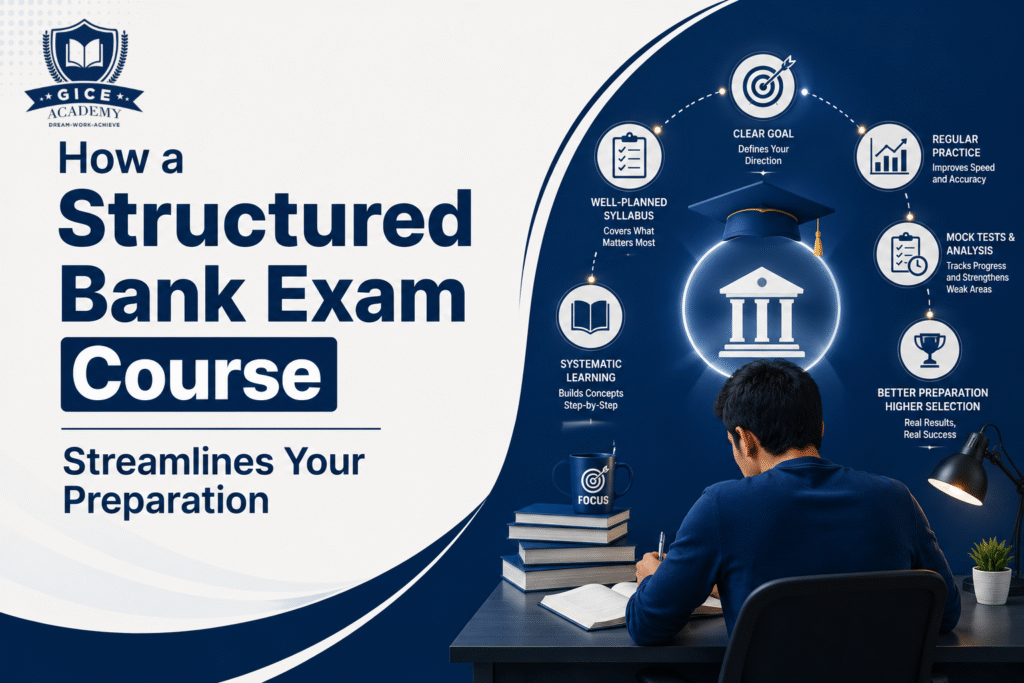
A Bank Exam Course is key for those aiming to pass banking exams in India. Many feel lost in the big syllabus, leading to burnout. A structured plan makes studying clear and easy, helping you reach your goals.
Joining online bank exam classes gives you a plan made by experts. It breaks down hard subjects into easy lessons. This way, you can focus on one thing at a time, helping you remember better.
Reducing Cognitive Load Through Organized Modules
A good course cuts down on mental stress. You get study materials that match the exam, saving you time. This organized structure makes learning easier, without the worry of useless info.
Learning in a logical order helps you understand numbers and reasoning well. Each part builds on the last, getting you ready for harder stuff. This way, you learn the basics first, then tackle harder problems.
Maintaining Consistency with Scheduled Milestones
Staying consistent is key to passing exams. A Bank Exam Course gives you a clear plan, with goals and mock tests. This lets you see how you’re doing and where you need to improve.
Online bank exam classes keep you on track with regular checks and feedback. Having deadlines for each topic helps you stay focused. This makes studying a productive habit.
| Feature | Self-Study | Structured Course |
| Study Material | Scattered/Unverified | Curated/Exam-Focused |
| Progress Tracking | Manual/Subjective | Data-Driven/Milestones |
| Doubt Resolution | Limited/Slow | Expert Mentorship |
| Time Management | High Risk of Delay | Optimized Schedule |
Common Pitfalls to Avoid During Your Preparation Journey
Success in banking is not by chance. Many candidates unknowingly harm their own chances. To succeed in Banking exam preparation, you need a solid plan and the will to avoid common mistakes.
Over-Reliance on Multiple Study Materials
Many people collect too many books, PDFs, and videos. This over-saturation can confuse you more than help. Different sources often teach different ways to solve the same problems.
Instead, pick one top-notch course and stick with it. Focusing on a single, reliable source helps you learn specific techniques better. This avoids the clutter of too much information.
Neglecting Revision Cycles
Many focus too much on learning new things. They don’t review what they’ve already learned. Without regular Revision techniques, your brain forgets important info. This can hurt your score on the test.
Make sure to set aside time each week to go over old material. Consistency is the key to keeping what you’ve learned. This way, your hard work will pay off on exam day.
| Common Mistake | Impact on Score | Corrective Action |
| Using too many books | High confusion | Stick to one primary source |
| Skipping reviews | Rapid knowledge loss | Implement weekly revision |
| Ignoring analytics | Stagnant progress | Track performance data |
By improving your study methods and focusing on Revision techniques, you can make your Banking exam preparation more effective. Steer clear of these common mistakes to keep your study sessions focused and successful.
Conclusion
Getting a job in a top financial institution is not just about working hard. It’s about using a smart study plan. This plan should be clear and efficient.
By getting help from experts and practicing a lot, you can improve your study skills. These skills are key to moving up in your career.
Good tips for passing the Bank exam mix feedback with hard work. Looking at your scores helps you see how you’re doing. This lets you improve your strategy and get better scores.
Staying disciplined is very important. Sites like Oliveboard or Adda247 help you keep up with your goals. Using these tips, you can do well in the tough world of Indian banking.
Your future in banking starts with your choices today. Take control of your studies by setting goals and following a plan. Success is waiting for those who prepare well and stay focused.