


The Consortium of National Law Universities (Consortium of NLUs) released the official CLAT 2027 notification 2026, confirming the exam date, registration schedule, eligibility criteria, application fee, and other details related to CLAT Admission 2027.
Online registration for admission to undergraduate and postgraduate law programmes at participating National Law Universities began on 3 August 2026 and will remain open until 31 October 2026. Candidates aspiring to join an NLU should carefully review their eligibility, exam pattern, and application process before applying. Candidates are advised to consult the official CLAT 2027 Information Brochure for complete and final details.
Start Your CLAT 2027 Preparation with GICE Academy
Prepare for CLAT admission 2027 with GICE Academy, with structured guidance, regular practice, and focused support designed to help aspirants build the skills needed for the entrance examination.
- Structured Guidance Across All Sections
- Legal Reasoning & Current Affairs Focus
- Mock Tests & Practice Material
- Doubt-Solving Support
- Personal Mentorship
CLAT Admission 2027 Important Dates
| Event | Date / Status |
|---|---|
| CLAT 2027 Notification Release | 22 July 2026 |
| Online Registration Begins | 3 August 2026, 10:00 AM |
| Last Date to Apply Online | 31 October 2026 |
| Last Date for Fee Payment | 31 October 2026 |
| Application Correction Window | To Be Notified |
| Admit Card | Mid-to-late November 2026 (Tentative) |
| CLAT 2027 Examination | 6 December 2026 (Sunday) |
| Examination Timing | 2:00 PM – 4:00 PM |
| PwD Extended Time | Up to 4:40 PM |
| Result | Third week of December 2026 (Tentative) |
| Counselling Begins | Last week of December 2026 (Tentative) |
CLAT 2027 Application Fee
| Category | Application Fee |
| General / OBC / PwD / NRI / PIO / OCI | ₹4,000 |
| SC / ST / BPL | ₹3,500 |
| Previous Years’ CLAT Question Papers (optional purchase) | ₹500 |
The ₹500 charge for previous years’ question papers is an optional add-on and is separate from the examination application fee.
Payment can be made online through net banking, credit card, debit card, or UPI. Candidates will bear any applicable bank transaction charges shown on the payment gateway. Once paid, the fee is nonrefundable and non-adjustable.
CLAT 2027 Eligibility Criteria
CLAT UG Eligibility
- Programme: Five-year integrated undergraduate law programme (B.A. LL.B. Hons. and equivalent degrees).
- Educational qualification: Candidates must have passed, or be appearing in, the Class 12 / 10+2 or equivalent examination from a recognised board.
- Minimum marks — General / OBC / PwD / NRI / PIO / OCI: 45% aggregate.
- Minimum marks — SC / ST: 40% aggregate.
- Appearing candidates: Candidates currently appearing for their Class 12 board examination are eligible to apply. Such candidates must produce proof of having passed the qualifying examination at the time of admission. Failure to provide this proof may affect their admission eligibility.
CLAT PG Eligibility
- Programme: Postgraduate law programme (LL.M.).
- Educational qualification: Candidates must possess an LL.B. or equivalent law degree from a recognised university or institution.
- Appearing candidates: Candidates in the final year of their qualifying degree may also apply.
Note on minimum marks: The reference material available for this notification contains two different sets of minimum qualifying percentages for PG eligibility — one indicating 55% (General) / 50% (Reserved category), and another indicating 50% (General/OBC/PwD/NRI/PIO/OCI) / 45% (SC/ST).
Because these figures do not match, the exact minimum percentage for CLAT PG 2027 eligibility should be verified against the official CLAT 2027 Information Brochure before relying on it.
CLAT 2027 Age Limit
There is no upper age limit for either the UG or PG programme under CLAT 2027.
CLAT 2027 Exam Pattern
| Parameter | Detail |
| Total Questions | 120 objective-type questions |
| Total Marks | 120 marks |
| Duration | 2 hours (120 minutes) |
| Negative Marking | 0.25 marks deducted for every incorrect answer |
| Mode | Offline / pen-and-paper |
Section-wise Structure (UG)
| Section | Approx. Weightage | What It Tests |
| English Language | ~20% | Comprehension, inference, tone, author’s argument, vocabulary in context |
| Current Affairs, including GK | ~25% | Passage-based current affairs and general knowledge |
| Legal Reasoning | ~25% | Application of legal principles and rules to given factual situations |
| Logical Reasoning | ~20% | Assumptions, flaws, analogies, arrangements, and related reasoning skills |
| Quantitative Techniques | ~10% | Data interpretation and basic mathematical concepts such as ratios, percentages, and averages |
The weightages above are approximate figures. Candidates should refer to the official CLAT 2027 Information Brochure for the confirmed marks distribution.
CLAT 2027 Syllabus
The following syllabus is drawn from the official CLAT 2027 UG and PG syllabus pages published by the Consortium of NLUs on consortiumofnlus.ac.in. The Consortium has confirmed that the syllabus and exam pattern remain unchanged for CLAT 2027.
CLAT UG 2027 Syllabus
The UG-CLAT 2027 is designed to test the comprehension and reasoning skills necessary for legal education, rather than prior subject knowledge, though general awareness helps in the Current Affairs section.
It is a 2-hour test of 120 multiple-choice questions carrying 1 mark each, with 0.25 marks deducted for every wrong answer, spread across five sections.
English Language
Candidates are given passages of about 450 words each, drawn from contemporary or historically significant fiction and non-fiction writing, at a level a Class 12 student could read in 5–7 minutes.
Questions test the ability to:
- Read and comprehend the main point, arguments, and viewpoints in the passage.
- Draw inferences and conclusions based on the passage.
- Summarise the passage.
- Compare and contrast different arguments or viewpoints in the passage.
- Understand the meaning of words and phrases in context.
Current Affairs, Including General Knowledge
Passages of up to 450 words are drawn from news, journalistic sources, and other non-fiction writing.
Questions may touch on legal information discussed in the passage but do not require knowledge beyond it.
This section tests awareness of:
- Contemporary events of significance from India and the world.
- Arts and culture.
- International affairs.
- Historical events of continuing significance.
Legal Reasoning
Passages of around 450 words relate to fact situations, legal matters, public policy questions, or moral and philosophical enquiries.
No prior knowledge of law is required, though general awareness of contemporary legal and moral issues helps.
Questions test the ability to:
- Identify and infer the rules and principles set out in the passage.
- Apply such rules and principles to various fact situations.
- Understand how changes to the rules or principles alter their application.
Logical Reasoning
Short passages of about 450 words are followed by one or more questions testing the ability to:
- Recognise an argument, its premises, and its conclusions.
- Read and identify the arguments set out in the passage.
- Critically analyse patterns of reasoning and assess how conclusions depend on premises or evidence.
- Infer what follows from the passage and apply it to new situations.
- Draw relationships and analogies, identify contradictions and equivalence, and assess arguments.
Quantitative Techniques
This section includes short sets of facts, propositions, or other textual representations of numerical information, followed by questions requiring candidates to:
- Derive, infer, and manipulate numerical information set out in the passage.
- Apply Class 10-level mathematical operations, including ratios and proportions, basic algebra, mensuration, and statistical estimation.
CLAT PG 2027 Syllabus
The PG-CLAT 2027 emphasises comprehension ability and is based on the mandatory subjects of the undergraduate law programme.
It is a 120-minute test with a single section of 120 objective-type questions carrying 1 mark each, with 0.25 marks deducted for every wrong answer.
The paper covers:
- Constitutional Law
- Jurisprudence
- Administrative Law
- Law of Contract
- Torts
- Family Law
- Criminal Law
- Property Law
- Company Law
- Public International Law
- Tax Law
- Environmental Law
- Labour and Industrial Law
Candidates are given extracts from primary legal materials; such as important court decisions, statutes, or regulations, in various fields of law.
Each passage is followed by questions testing the ability to:
- Read and comprehend the issues, arguments, and viewpoints discussed in the passage.
- Show awareness of legal issues and facts related to the passage and the judgment or statute it is drawn from.
- Summarise the passage.
- Apply knowledge of the field of law discussed in the passage.
Source: CLAT 2027 UG and PG Syllabus, published by the Consortium of National Law Universities at consortiumofnlus.ac.in.
Master Every CLAT Section with GICE Academy
- Topic-Wise Classes for All Five Sections
- Weekly Mock Tests
- Legal Reasoning Practice Sets
- Current Affairs Updates
- Speed & Accuracy Building Sessions
CLAT 2027 Participating NLUs
The following National Law Universities are listed as participating institutions in the reference material used for this notification:
- National Law School of India University (NLSIU), Bengaluru
- NALSAR University of Law, Hyderabad
- National Law Institute University (NLIU), Bhopal
- The West Bengal National University of Juridical Sciences (WBNUJS), Kolkata
- National Law University, Jodhpur
- Hidayatullah National Law University (HNLU), Raipur
- Gujarat National Law University (GNLU), Gandhinagar
- Gujarat National Law University, Silvassa Campus
- Dr. Ram Manohar Lohiya National Law University (RMLNLU), Lucknow
- Rajiv Gandhi National University of Law (RGNUL), Punjab
- Chanakya National Law University (CNLU), Patna
- National University of Advanced Legal Studies (NUALS), Kochi
- National Law University Odisha (NLUO)
- National University of Study and Research in Law (NUSRL), Ranchi
- National Law University and Judicial Academy, Assam (NLUJA)
- Damodaram Sanjivayya National Law University (DSNLU), Visakhapatnam
- Tamil Nadu National Law University (TNNLU), Tiruchirappalli
- Maharashtra National Law University (MNLU), Mumbai
- Maharashtra National Law University (MNLU), Nagpur
- Maharashtra National Law University (MNLU), Aurangabad / Chhatrapati Sambhajinagar
- Himachal Pradesh National Law University (HPNLU), Shimla
- Dharmashastra National Law University (DNLU), Jabalpur
- Dr. B.R. Ambedkar National Law University (DBRANLU), Haryana
- National Law University and Judicial Academy, Agartala (NLUT)
- Rajiv Gandhi National University of Law, Prayagraj (RPNLUP)
- Indian Institute of Information Technology and Law (IIULER), Goa
- National Law University, Meghalaya, Shillong
Important note: The reference material states that 26 NLUs are participating in CLAT 2027, but the accompanying list contains 27 institutions. Separately, another part of the reference material indicates that the Consortium’s executive committee has reportedly cleared the induction of NLU Tripura (Agartala) and NLU Meghalaya (Shillong) into the all-India CLAT seat-sharing pool for 2027, which would account for the higher count.
This has not been treated as a confirmed resolution of the discrepancy and should be verified against the official CLAT 2027 Information Brochure before final publication.
Information You’ll Need to Provide
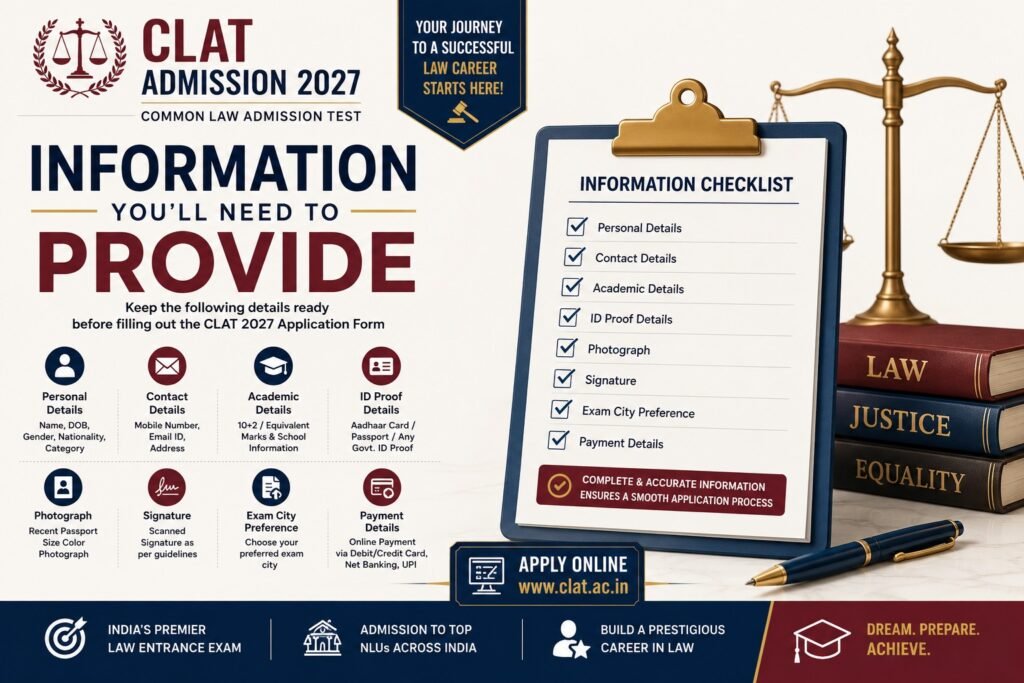
Before starting the CLAT admission 2027, keep the following account and personal information ready. These are not files to upload, they are the details the online form will ask you to fill in.
Contact Details
- Valid email ID
- Valid mobile number
Personal, Educational, and Address Details
- Personal details
- Educational details
- Address details
Documents Required for CLAT Admission 2027 Application
In addition to the information above, the following documents must be scanned and uploaded as part of the application.
Educational Documents
- Class 10 marksheet / certificate
- Class 12 marksheet / certificate, where applicable
Photograph, Signature, and Certificates
- Recent photograph
- Signature
- State domicile certificate, where applicable
- Category certificate, where applicable (SC/ST/OBC/EWS)
- Relevant certificate issued by a competent authority, for PwD or BPL candidates
Document Upload Specifications
| Document | Maximum Size | Format |
| Photograph | 500 KB | JPG/JPEG |
| Signature | 100 KB | JPG/JPEG |
| State Domicile Certificate | 2 MB |
Category, PwD, and BPL certificates are also required where applicable; specific file-size or format requirements for these documents have not been notified in the available reference material.
How to Apply Online for CLAT 2027
Candidates can follow these steps to complete the CLAT 2027 application:
- Visit the official CLAT / Consortium of NLUs website.
- Register as a new user.
- Fill in the online application form.
- Enter personal, educational, and other required details.
- Upload the required documents.
- Pay the applicable application fee online.
- Carefully review all information entered.
- Correct any errors before final submission.
- Submit the application form.
- Save, download, and print a copy of the final submitted application for future reference.
Note: NLU preference filling for CLAT 2027 is expected to take place after the result is declared, not at the time of registration. Candidates do not need to rank their NLU choices while filling the initial application form.
Candidates are strongly advised to read the official CLAT 2027 Information Brochure carefully before submitting their application.
Important Instructions for Applicants
- Check the eligibility criteria carefully before applying.
- Enter personal and educational details accurately.
- Ensure that your name and date of birth match your Class 10 certificate and other official records.
- Provide a valid, active email ID and mobile number.
- Upload a recent, clear photograph and signature in the specified format and size.
- Upload the applicable category, domicile, PwD, or BPL certificates where relevant.
- Pay the application fee before final submission — applications submitted without fee payment will not be considered complete.
- Review the entire application form before submitting it.
- Incomplete applications may be rejected.
- Save a copy of the final submitted application for your records.
CLAT Admission 2027 Application Correction Window
The Consortium of NLUs is expected to open an application correction window after the registration process closes. This facility is currently marked To Be Notified.
Based on the available reference material, the correction window is expected to allow candidates to log in to their application account and edit certain permitted details, potentially including:
- Category and seat reservation / NLU preferences
- OBC category status (Non-Creamy Layer or Creamy Layer)
- Certain personal details
The exact list of editable fields and the correction procedure will depend on the official notification issued when the correction window opens. Candidates should check the official CLAT website for confirmed instructions at that time.
CLAT 2027 Official Website
Consortium of National Law Universities official website: consortiumofnlus.ac.in
Candidates should rely on the official website and the official CLAT 2027 Information Brochure published there for the most accurate and final information.
Conclusion
The official CLAT admission 2027 official notification has confirmed all the key details — exam date, registration schedule, application fee, and eligibility criteria.
Registration is currently open and will close on 31 October 2026, with the examination scheduled for 6 December 2026.
The Consortium has confirmed that the syllabus and exam pattern remain unchanged for this cycle, while the number of participating NLUs may see a slight increase.
Candidates are advised to complete their application well before the deadline and to keep the required documents ready in advance to avoid last-minute issues.
Why Aspirants Choose GICE Academy for CLAT Preparation
- Expert Faculty for Legal Reasoning & Aptitude
- Regular Mock Tests
- Current Affairs & GK Support
- Doubt-Solving Sessions
- Personal Mentorship for Each Student
Important Note / Disclaimer
This notification is based on information available at the time of publication and is intended to help candidates understand the CLAT 2027 admission process at a glance.
Certain details, including the exact PG eligibility percentage and the confirmed number of participating NLUs, carry conflicting figures in the available source material and should be verified against the official CLAT 2027 Information Brochure on consortiumofnlus.ac.in before candidates rely on them for admission purposes.
Dates, fees, and other particulars are subject to change as per official notifications issued by the Consortium of NLUs.