

Many students think success in India’s top MBA test comes from just being smart. But, getting a 99+ percentile score is about consistent, structured effort. This guide will show you how to prepare well for the CAT exam.
To hit your goal, plan for 8 to 10 months of study. Spend 2 to 3 hours each day on focused learning. Discipline is your greatest asset on this path.
Your study plan should focus on three main areas. These are Verbal Ability and Reading Comprehension, Data Interpretation and Logical Reasoning, and Quantitative Ability. This plan works for everyone, whether you’re new to exams or have a busy job. It helps you tackle the CAT with confidence. By sticking to this plan, you’re on your way to academic success and future career growth.
Key Takeaways
- Success depends on long-term consistency, not just talent.
- A realistic timeline is 8 to 10 months of study.
- Daily practice of 2 to 3 hours is key for progress.
- Mastering the three distinct sections is vital for a high score.
- Structured planning helps working professionals manage their busy lives.
Understanding the CAT Exam Structure and Syllabus
Success in the CAT 2026 starts with knowing the exam well. Good CAT exam preparation means understanding how it tests your skills. Learning the format early helps you plan better, using your strengths and working on weaknesses.
Decoding the Exam Pattern for CAT 2026
The exam is a computer test that checks your skills in three areas. Each part has a time limit, so you need to stay focused. Knowing this, helps you make a good plan for the test.
The exam follows a set order, but the number of questions can change. Getting used to the current pattern helps you practice under real test conditions. Being consistent is key for top scores.
Analyzing the Weightage of VARC, DILR, and QA
The exam has three main parts: VARC (Verbal and Reading Comprehension), DILR (Data and Logic Reasoning), and QA (Math). Each part is important, and ignoring any can hurt your score.
Here’s a table showing what each section focuses on:
| Section | Primary Focus | Skill Evaluated |
| VARC | Reading & Grammar | Critical Thinking |
| DILR | Data & Logic | Analytical Reasoning |
| QA | Mathematics | Problem Solving |
Spreading your study time evenly is key. Plan your study hours based on what’s hard for you in each area.
Setting Realistic Goals for a 99 percentile
Aiming for a 99 percentile needs more than just effort. It requires a strict plan. Make sure you study everything and have time for review. Setting clear goals helps you see how you’re doing.
When aiming high, every point matters. Focus on being accurate first, then speed will come with practice. Stick to your plan to do well in this tough competition.
Building a Strong Foundation in Verbal Ability and Reading Comprehension
To do well in CAT exam preparation, you need to work hard on the verbal section. The VARC part is key for those aiming high. Improving your linguistic skills can really boost your score in the CAT 2026.
Developing Consistent Reading Habits
Reading every day is the best way to get better at understanding quickly. Spend at least forty-five minutes a day on different types of texts. This includes editorials, journals, and long essays.
This habit makes you comfortable with hard, academic words found in VARC passages. Reading about different topics helps you not get surprised by new subjects in the test. Reading about philosophy, economics, or science regularly makes you strong for long tests.
Over time, you’ll get better at understanding complex ideas fast.
Mastering Grammar and Vocabulary Fundamentals
Grammar is key for sentence correction and summary questions. You don’t need to know every rule, but, understanding the logic of sentence structure is important.
Building your vocabulary should be a constant effort, not something you do just before the test. Learn words in context, not just by heart. This strategic approach helps you remember meanings and how authors use language.
Techniques for Solving Reading Comprehension Passages
Breaking down a passage well is a skill that sets top scorers apart. First, find the main argument or the “author’s intent.” This mental map helps you understand the text better.
When you find hard paragraphs, break them into smaller parts. Look at transition words, as they show changes in the author’s thought. The table below shows how different reading sources help your prep:
| Source Type | Primary Benefit | Difficulty Level |
| National Newspapers | Current Affairs & Logic | Moderate |
| Academic Journals | Complex Vocabulary | High |
| Opinion Editorials | Argument Analysis | Moderate |
| Classic Literature | Nuance & Tone | High |
Developing Proficiency in Data Interpretation and Logical Reasoning
The Data Interpretation and Logical Reasoning section is key for your CAT exam preparation. It tests how well you handle information under pressure, not just math skills. You need to move from just memorizing to analytical thinking.
Approaching Data Interpretation Sets
Data interpretation is about finding important details in charts and graphs. First, scan the whole set to see what data you’re dealing with. Categorizing the data early helps you pick the best way to solve it.
- Find trends or unusual data points before doing hard math.
- Use quick methods for division and multiplication to save time.
- Check the units and scales in charts to avoid mistakes.
Strategies for Solving Complex Logical Reasoning Puzzles
Logical reasoning puzzles in the CAT 2026 test have many rules that seem hard at first. Break these rules into smaller parts. Visualization tools like grids help organize the information.
Start by finding the “fixed” parts that give you a solid base. Then, test different scenarios for the other parts. Systematic elimination of wrong options helps find the right answer faster than guessing.
Improving Speed and Accuracy in DILR
Getting better at DILR takes time and effort. Focus on being accurate, not just trying to do lots of sets. This is because wrong answers can hurt your score a lot. Practice with top-notch DILR materials to build your skills.
To do well on CAT 2026, review your practice sessions closely. See which DILR types take too long and change your approach. Regularly reviewing your mistakes helps avoid making them again on the real test.
Mastering Quantitative Aptitude for High Scores
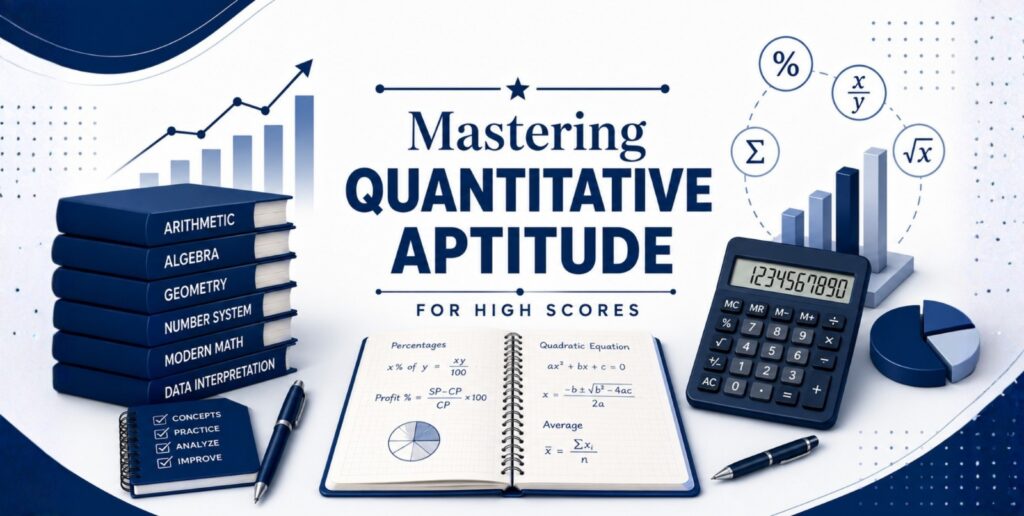
The Quantitative Aptitude section is a big challenge in your CAT 2026 journey. To get a high score, you need to understand concepts well and practice smartly. By using the right strategies, you can make this section your strongest part in CAT exam preparation.
Strengthening Core Mathematical Concepts
A strong math base is key for solving tough problems. Focus on arithmetic, as it’s the base of the QA section. Practice with numbers and percentages to get faster at harder questions.
- Work on mental math to use calculators less.
- Regularly review number theory basics.
- Practice solving arithmetic problems in different ways to be more flexible.
Advanced Problem-Solving Techniques for Algebra and Geometry
Algebra and geometry questions are often the hardest in the CAT 2026 exam. Instead of just trying hard, learn to spot patterns and use shortcuts. This skill helps you solve problems faster.
Here’s a table to help you focus on the right areas for these topics:
| Topic | Key Focus Area | Difficulty Level |
| Algebra | Quadratic Equations | Moderate |
| Geometry | Circle Theorems | High |
| Algebra | Logarithms | Moderate |
Managing Time During the Quantitative Aptitude Section
Good time management is key to a high score in the QA section. Find “sitters” (i.e., easy questions) to quickly build up your score. This is a big part of CAT exam preparation.
Prioritization is critical when time is short. If a question is too hard, skip it and come back later. Stay calm to avoid losing points on questions you can solve.
Strategic CAT Exam Preparation Through Mock Tests
Full-length mock tests are key for success in the CAT 2026. They show your current level and what you need to work on. Testing often is vital for good CAT exam preparation.
Selecting the Right Mock Test Series
Picking a good test series is very important. Look for ones that are similar to the real exam. A good series has many types of questions to test your knowledge.
When looking at test providers, think about these things:
- Interface Similarity: Does it look like the real exam?
- Detailed Analytics: Does it give you detailed feedback?
- Difficulty Variance: Are the questions balanced?
- Peer Comparison: Can you see how you compare to others?
Analyzing Mock Test Performance and Identifying Weaknesses
Reviewing your test is just as important as taking it. Spend time on questions you got wrong. Understanding why you missed a question is more valuable than just knowing the answer.
Keep a log to track your progress. By finding patterns in your mistakes, you can improve your CAT exam preparation. This way, you won’t make the same mistakes again.
Simulating Exam Day Conditions
To do your best, train under exam pressure. Take your mock tests in a quiet place without distractions. Building mental stamina is as important as learning math.
Practice under timed conditions to adjust your clock. This reduces stress and boosts focus on exam day. It turns your study into a real, high-stakes training.
Creating a Balanced Study Schedule
Having a daily plan can help you score high. Success in exams comes from using your study time wisely. This ensures you grow consistently.
Allocating Time for Concept Building and Practice
Good CAT exam preparation means learning and practicing. Use your best hours for learning new things. Save later times for practicing.
Here’s a good way to split your study time:
- Concept Building: Spend 60% of your time on core concepts.
- Active Practice: Use 40% for solving tests and checking your work.
Balancing Preparation with Professional or Academic Commitments
Many people study while working or completing their undergraduate degrees. The trick is to use every chance to learn, even in short breaks.
Staying consistent is better than long study sessions. Break your study into small parts. This keeps you moving forward without feeling too stressed.
Utilizing Weekends for Intensive Revision
Weekends are great for deep study and review. Use them to practice like you’re in the real test. Find what you need to work on.
Focus on these three things to hit the 99 percentile:
- Full-length Mock Tests: Do at least one full test to get used to it.
- Error Analysis: Go over every wrong answer to learn from it.
- Strategic Planning: Update your study plan for the next week based on how you’re doing.
Make your weekend a dedicated training ground. This way, your prep stays on track. It helps you get faster and more accurate, leading to better test scores.
Essential Resources and Study Materials
Getting the right study materials is key for CAT exam preparation. There’s a lot of content out there. It’s important to focus on the best resources. This helps you aim for a 99 percentile score.
Recommended Books and Online Platforms
For Quantitative Aptitude and Data Interpretation, books by Arun Sharma and Nishit Sinha are top choices. They cover important topics and have lots of practice problems. Using these books regularly helps you get better at math.
Online platforms like IMS, TIME, and Career Launcher also offer great digital tools. They have:
- Adaptive learning that fits your skill level.
- Video lectures that make hard math easy.
- Interactive dashboards to track your progress.
Leveraging Previous Year Question Papers
Old question papers are the best way to see how the exam has changed. They show which topics are most important. Looking at these papers helps you spot patterns for your CAT exam preparation.
Use these papers to practice under timed conditions. This helps you get used to the test’s pressure. It’s a key strategy for those aiming for a 99 percentile.
Utilizing Peer Groups and Mentorship
Preparation doesn’t have to be alone. Join groups on Telegram or Discord to talk about tough problems. Learning together helps you find areas you might not see on your own.
Mentors offer the guidance you need to tackle the exam. They help you improve your strategy and support you when things get tough. Working with mentors keeps your study plan focused on your goals.
Managing Stress and Maintaining Consistency
Getting ready for the CAT exam is like running a long race. It tests your mental strength as much as your math skills. Learning complex formulas is key, but your mental game is what really matters. It can help you reach the 99 percentile.
Psychological Preparation for Competitive Exams
Building a strong mind starts with knowing progress isn’t always smooth. See mock test scores as data, not your worth. This view is key to good CAT exam preparation.
Using visualization can keep you calm under pressure. It trains your brain for big moments. Mental toughness grows with practice.
Overcoming Burnout During Long-Term Preparation
Burnout hits when you ignore your body or study too much without breaks. Rest days are essential for your brain to heal. Consistency means showing up regularly, not studying all day.
If you’re feeling burnt out, break your study into smaller bits. This lowers stress and you stop feeling overwhelmed. Sustainable habits beat intense, short bursts.
Staying Motivated Throughout the Journey
Staying motivated means keeping your goals in sight. When progress seems slow, think about why you want an MBA. Keeping a journal shows how far you’ve come in CAT exam preparation.
Being around supportive friends helps a lot. Sharing struggles with others aiming for the 99 percentile makes it feel normal. Here are ways to manage stress:
| Technique | Primary Benefit | Frequency | Impact Level |
| Mindfulness Meditation | Reduces Anxiety | Daily | High |
| Physical Exercise | Boosts Energy | Weekly | Medium |
| Structured Breaks | Prevents Burnout | Hourly | High |
| Peer Discussion | Emotional Support | Monthly | Medium |
Conclusion
Success in competitive management entrance tests needs discipline and planning. Your CAT exam prep is key to your future in top business schools like IIM Ahmedabad or IIM Bangalore.
Getting a 99 percentile is possible with regular study habits. Improve your analytical skills and keep your mental health first.
This roadmap gives you the tools to tackle tough sections easily. Practice every day to get better at solving problems fast and accurately.
Believe in the hard work you’ve put into your cat exam prep. Stick to your schedule to show your best on test day. Contact us for more details, expert guidance, and the latest CAT exam updates.